
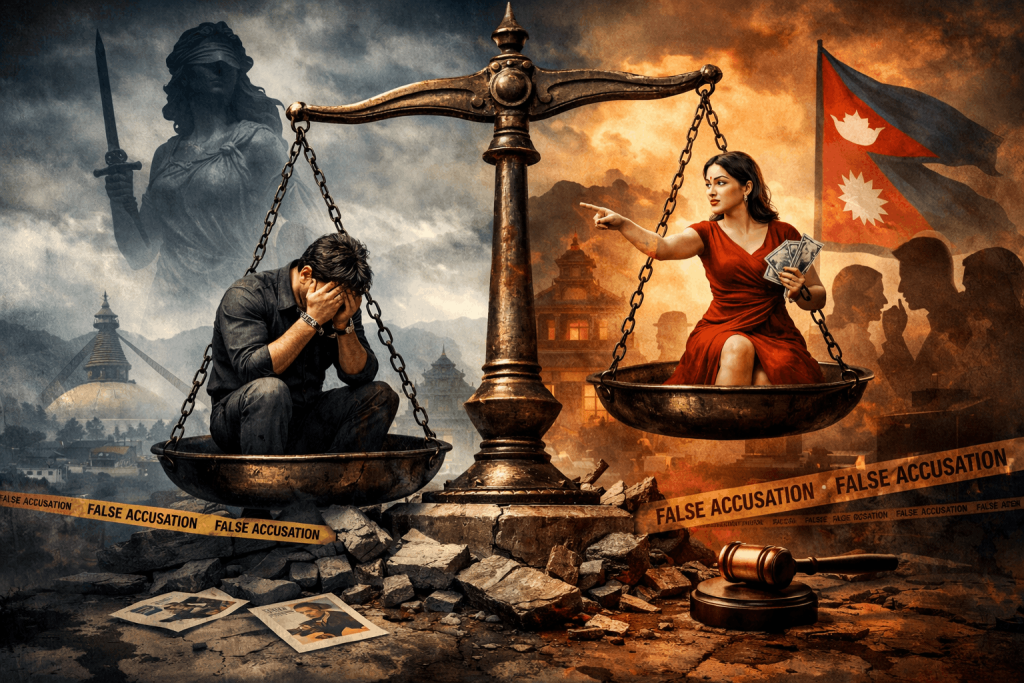
When Justice Turns Silent: The Untold Reality of False Accusations, Manipulation, and Legal Fear in Nepal
Introduction: The Weight of an Accusation
In Nepal, justice is meant to be blind—unaffected by gender, power, or emotion. Yet, in reality, many situations unfold differently. The moment an accusation is made, especially in sensitive cases, society reacts instantly. Sympathy flows. Opinions rise. And often, judgment arrives before evidence.
The issue of false accusations in Nepal remains largely unspoken. Not because it is rare, but because it exists in a fragile space—where raising questions can be misunderstood as denying real victims.
But justice cannot survive on silence.
If a system protects only one side without equal scrutiny, it risks creating another form of injustice—quiet, invisible, and deeply damaging.
The Legal Framework: Protection With Gaps
Nepal’s laws have evolved significantly to protect women from violence, harassment, and exploitation. This progress is necessary and important. However, legal experts and human rights observers have pointed out structural gaps in how these laws are defined and applied.
For instance, a detailed legal review by the Human Rights and Justice Centre highlights that Nepal’s sexual violence laws are still limited in scope and often exclude male victims from legal recognition, especially in cases like rape.
You can explore their analysis here:
👉 https://hrjc.org.np/nepals-legislation-on-sexual-violence-is-insufficient-and-poorly-implemented/
This creates a critical imbalance:
- Protection exists—but not equally
- Recognition exists—but not universally
- Justice exists—but not always symmetrically
When laws are not fully inclusive, they can unintentionally create vulnerability—not just for victims, but also for those falsely accused.
Emerging Patterns: Manipulation, Honey Traps, and Fear
In recent years, Nepal has witnessed a rise in cases involving emotional manipulation, honey trapping, and blackmail. These are not assumptions—they are documented incidents reported by media and legal observers.
A case reported by Nepal Minute revealed a coordinated honey trap operation where a victim was lured into a relationship and later threatened with false allegations, leading to an extortion demand of nearly Rs. 50 million.
Read the case here:
👉 https://www.nepalminute.com/detail/1581/honeytrap-case-court-sends-woman-to-judicial-custody
Similarly, investigative insights from Nepal Investigative Multimedia Journalism Network describe how such schemes typically follow a pattern:
- Emotional connection
- Trust building
- Strategic compromise
- Legal threat or accusation
- Financial or reputational extortion
Full report here:
👉 https://www.nimjn.org/en/detail/187/honey-trap-np
These patterns highlight a dangerous reality:
👉 The strongest weapon is not force—it is fear of accusation.
Social Media: The New Courtroom
In today’s Nepal, justice does not begin in court—it begins online.
Platforms like Facebook and TikTok have transformed how society reacts to allegations. Within minutes:
- A post goes viral
- Public opinion forms
- Names are judged
- Reputations collapse
Even before legal processes begin, the accused faces a social trial.
And once a reputation is damaged publicly,
even legal innocence cannot fully restore it.
This creates a system where:
- Accusation becomes evidence
- Emotion becomes judgment
- Silence becomes survival
Data and Reality: A System Under Pressure
The challenge is not just perception—it is structural.
According to Amnesty International, Nepal still struggles with a “culture of impunity”, where many cases fail to reach fair conclusions due to weak enforcement and systemic inefficiencies.
Their findings show:
- Many victims—across genders—do not report crimes due to lack of trust
- Legal processes are often slow and inconsistent
- Accountability mechanisms remain limited
You can review their findings here:
👉 https://www.amnesty.org/en/latest/news/2024/05/descent-based-discrimination-against-dalits-in-nepal/
When a system lacks consistency,
it becomes vulnerable to misuse—from any side.
The Other Truth: Women Still Face Deep Injustice
To speak honestly, we must acknowledge a parallel truth.
Reports from United Nations Nepal show that women continue to face:
- Domestic violence
- Harmful traditional practices
- Social discrimination
Explore the report:
👉 https://un.org.np/node/2497
Additionally, research published in SAGE Journals highlights cases of witchcraft accusations against women, leading to severe physical and psychological harm.
This matters.
Because the goal is not to deny women’s suffering.
The goal is to ensure justice does not become selective.
The Core Issue: Misuse Meets Weakness
When we connect all these realities, one truth emerges:
The problem is not gender—it is misuse + weak systems + social bias.
🔹 System Weakness
- Delayed investigations
- Lack of forensic strength
- Limited accountability
🔹 Misuse of Legal Fear
- Threat of accusation as leverage
- Exploitation of social sympathy
🔹 Social Bias
- Immediate emotional alignment
- Lack of evidence-based thinking
🔹 Silence of Men
- Fear of not being believed
- Social stigma around vulnerability
This combination creates a dangerous imbalance where truth struggles to survive.
The Psychology of the Unheard Man
Why do many men remain silent, even when facing manipulation or false accusations?
Because the consequences of speaking are often devastating:
- Family reputation damage
- Career loss
- Social isolation
- Mental stress and depression
In a society where masculinity is associated with strength,
admitting victimhood becomes a weakness.
So silence becomes a shield.
But silence also allows the problem to grow.
Internal Reflection: A Society at Crossroads
Nepal today stands at a critical point.
On one side:
- A necessary movement for women’s rights
On the other:
- A growing concern about fairness in implementation
If these two realities are not balanced,
they will not cancel each other—they will collide.
And in that collision,
truth will be the first casualty.
The Way Forward: Justice Beyond Gender
The solution is not to reduce protection for women.
The solution is to expand fairness for everyone.
✔️ Legal Reforms
- Introduce gender-neutral definitions in sensitive laws
- Penalize proven false accusations strictly
- Ensure faster legal processes
✔️ Institutional Strengthening
- Independent investigation bodies
- Transparent police procedures
✔️ Social Awareness
- Encourage critical thinking before judgment
- Reduce social media trials
✔️ Safe Platforms for Men
- Legal aid support
- Mental health counseling
- Awareness campaigns
🕊️ Poem: When Silence Becomes the Verdict
In a land where voices rise so fast,
truth often waits in shadows cast.
A whisper grows into a flame,
and innocence forgets its name.
Not every story told is whole,
not every tear reveals a soul.
Between the lines where rumors grow,
the quiet truth begins to slow.
A word can build a broken fate,
before the court can investigate.
And justice, dressed in human view,
sometimes forgets what’s really true.
A man may stand with silent eyes,
beneath the weight of judged disguise.
Not guilty proved, nor innocence heard,
just lost inside a spoken word.
Yet truth still breathes in patient time,
beyond the noise, beyond the climb.
It waits where hearts are brave and still,
beyond the rush of human will.
So let us walk with care and light,
not every shadow means the night.
For justice lives when hearts can see—
beyond emotion… toward clarity.
Conclusion: Justice Must Not Be Selective
The conversation around false accusations in Nepal is not about denying victims—it is about protecting justice.
Because justice that listens to only one side
is not justice—it is imbalance.
A strong nation is not built by choosing sides.
It is built by choosing truth.
When justice turns silent,
society must learn to listen again.
Only then can Nepal move toward a system where:
- The innocent are protected
- The guilty are proven
- And truth stands above all

