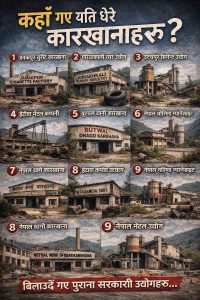
Nepal once believed in production, not dependency. Across the country, Nepal government-owned factories produced cement, textiles, rubber goods, cigarettes, metals, and essential materials. These factories created jobs, strengthened regional economies, and reduced imports.
Nepal Government-Owned Factories: closed
Today, many Nepal government-owned factories stand abandoned—rusted machines, broken walls, and forgotten workers. This collapse is not just about factories; it is about lost confidence, weakened sovereignty, and an economy pushed toward dependency.
To rebuild Nepal’s economy sustainably, we must first face the painful truths behind the decline of Nepal government-owned factories.
Why Still Matter
Nepal government-owned factories were never meant to replace private businesses. They were created to:
Protect national economic interests
Generate employment beyond Kathmandu
Reduce import dependency
Build industrial skills
Stabilize prices of essential goods
When Nepal government-owned factories collapsed, Nepal did not become more efficient—it became more vulnerable.
Nepal’s sustainable economic future
Truth 1: Nepali Factories Did Not Fail Naturally
A common narrative suggests Nepal government-owned factories failed because they were outdated or inefficient. This is misleading.
Most factories did not shut down suddenly. They declined slowly due to:
budget neglect
delayed modernization
lack of reinvestment
policy uncertainty
Nepal government-owned factories were weakened step by step until collapse became inevitable.
Truth 2: Political Interference Weakened Nepal Owned Factories
Industries require professional leadership and long-term planning. Instead, Nepal government-owned factories were often controlled by political appointments.
With every government change:
management changed
priorities shifted
long-term plans were abandoned
This instability destroyed productivity and accountability. Nepal government-owned factories became political tools instead of national assets.
Truth 3: Import Dependency Replaced Domestic Production
As Nepal government-owned factories declined, imports quietly increased. Products once manufactured locally were replaced by foreign goods.
This shift:
drained national currency
weakened local supply chains
rewarded middlemen instead of producers
When Nepal government-owned factories stopped operating, imports increased—and the economy lost its balance.
Manufacturing and employment trends in Nepal
Truth 4: Corruption and Commission Culture Accelerated the Collapse
The decline of Nepal government-owned factories cannot be separated from corruption.
Common patterns included:
inflated procurement contracts
unnecessary outsourcing
asset stripping
commission-driven policy decisions
When factories closed, production stopped—but financial interests shifted elsewhere. The economy lost, while a few benefited.
Truth 5: Workers and Regions Paid the Highest Price
The closure of Nepal government-owned factories directly impacted workers, families, and regional economies.
Consequences included:
mass unemployment
forced migration
loss of skilled labor
collapse of local markets
Economic decline is not abstract—it affects real lives.
Truth 6: Privatization Lacked Vision and Protection
Privatization itself is not the problem. The problem was how it was done.
Many Nepal government-owned factories were:
privatized without transparency
sold without performance obligations
transferred without worker safeguards
In several cases, land mattered more than production. Without regulation, privatization became another path to shutdown.
Truth 7: Citizens Stopped Asking Questions
Perhaps the most painful truth is silence.
Key questions were ignored:
Who decided to close Nepal government-owned factories?
Where are the audit reports?
Why was no one held accountable?
Who benefited from increased imports?
Democracy weakens when citizens stop questioning economic decisions.
Learning from the Collapse to Rebuild the Economy
Nepal does not need to recreate old factories exactly as they were. But it must learn from the failure of Nepal government-owned factories.
A realistic rebuilding approach includes:
modern, green industries
public–private–community partnerships
professional, transparent leadership
strong labor protection
regional industrial hubs beyond Kathmandu
Rebuilding Nepal government-owned factories in a modern form is essential for economic recovery.
This election season and beyond, citizens should calmly ask:
Why were Nepal government-owned factories not modernized?
Who made the decisions to shut them down?
Where are the investigation and audit findings?
Why was long-term industrial policy ignored?
Who benefited when factories closed and imports increased?
Asking questions is not opposition—it is participation.
A Bhuone Reflection: Pain with Purpose
The collapse of Nepal government-owned factories is painful because it reveals deeper systemic failures. But pain is also information.
Nepal still has:
natural resources
young workforce
technical knowledge
opportunity for reform
What is required now is memory, accountability, and courage.
Conclusion: Rebuilding Starts with Truth
The story of Nepal government-owned factories is not only about collapse—it is about lessons we must use wisely.
Rebuilding the economy does not start with slogans. It starts with facing uncomfortable truths, restoring accountability, and designing a future that values production over dependency.
This is how Nepal rebuilds.
This is the Bhuone way. 🌱
ID used to identify users for 24 hours after last activity
24 hours
_gat
Used to monitor number of Google Analytics server requests when using Google Tag Manager
1 minute
_gali
Used by Google Analytics to determine which links on a page are being clicked
30 seconds
_ga_
ID used to identify users
2 years
__utmx
Used to determine whether a user is included in an A / B or Multivariate test.
18 months
_ga
ID used to identify users
2 years
__utmz
Contains information about the traffic source or campaign that directed user to the website. The cookie is set when the GA.js javascript is loaded and updated when data is sent to the Google Anaytics server
6 months after last activity
__utmv
Contains custom information set by the web developer via the _setCustomVar method in Google Analytics. This cookie is updated every time new data is sent to the Google Analytics server.
2 years after last activity
__utmt
Used to monitor number of Google Analytics server requests
10 minutes
__utmb
Used to distinguish new sessions and visits. This cookie is set when the GA.js javascript library is loaded and there is no existing __utmb cookie. The cookie is updated every time data is sent to the Google Analytics server.
30 minutes after last activity
__utmc
Used only with old Urchin versions of Google Analytics and not with GA.js. Was used to distinguish between new sessions and visits at the end of a session.
End of session (browser)
_gac_
Contains information related to marketing campaigns of the user. These are shared with Google AdWords / Google Ads when the Google Ads and Google Analytics accounts are linked together.