

Climate Change in Nepal: 15 Shocking Impacts on Food & Farming + Real Solutions
Climate change in Nepal isn’t a distant idea anymore — it’s happening here and now. In the remote hills of Mustang, apple orchards that once thrived are shrinking because snow that once grounded moisture and protected tree roots is disappearing. Local farmers tell of 2023 crop yields halving compared to a decade ago due to unpredictable rain and drought — forces they can neither forecast nor control. This is not just an environmental story — it’s a story of families, farms, and futures being reshaped by climate imbalance.
Yet in the midst of growing uncertainty, there’s an undercurrent of hope — sustainable solutions rooted in community, technology, and nature can help Nepal not just survive, but thrive in a changing world.
Understanding Climate Change in Nepal
Climate change in Nepal refers to long-term shifts in temperature, rainfall patterns, and weather extremes that are increasingly affecting the country’s environment, agriculture, and livelihoods. Nepal’s geography — from the low-lying Terai plains to the high Himalayas — makes it uniquely vulnerable to climate fluctuations.
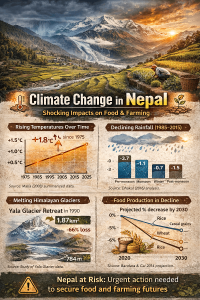
Since the 1970s, Nepal has seen rising average temperatures by as much as 0.28°C per decade, and these increases are altering the timing and volume of rainfall across regions.
This isn’t just climate jargon — the livelihoods of millions depend on these patterns, especially because:
-
Roughly 60–66% of Nepal’s population depends on agriculture and related sectors for income and subsistence.
-
Most farms rely on monsoon rains, making unpredictable seasons a direct threat to food production.
Simply put, as weather becomes less predictable, Nepal’s food systems become more fragile.
Why Climate Change in Nepal Matters Today
Climate Change in Nepal is no longer only an environmental issue — it is directly reshaping how rural families earn, eat, migrate, and survive. Changing rainfall patterns reduce crop reliability, forcing farmers to seek off-farm income or migrate to cities and foreign labor markets. When agriculture weakens, local food prices rise, nutrition suffers, and community stability becomes fragile. Understanding this human dimension of Climate Change in Nepal helps policymakers, youth innovators, and communities design solutions that protect both land and livelihoods.
Climate change affects Nepal at multiple levels:
🌦️ 1. Reduced Crop Yields & Food Security
Studies show climate change is linked to reduced production of staples like rice, wheat, and cereal grains, with predictions of significant declines in output by 2030 if current trends continue.
These disruptions directly threaten food security in Nepal, especially for rural families dependent on seasonal harvests.
🌧️ 2. Erratic Rainfall & Weather Extremes
Unpredictable monsoons, intense floods, and extended dry spells are becoming more common, disrupting planting cycles and soil moisture. Climate change accelerates soil degradation in Nepal, reducing fertility and increasing erosion in hill agriculture systems.
🏔️ 3. Loss of Snowfall & Glacial Retreat
Shrinking snow cover in high altitudes affects downstream water availability during dry seasons — intensifying water stress for irrigation and farming.
📉 4. Increased Pest & Disease Pressure
Warmer temperatures and irregular humidity favor pest outbreaks, imposing new threats to crops that previously had predictable growing seasons.
👩🌾 5. Livelihood Vulnerability
Smallholder farmers, who depend on climate stability and traditional seasonal knowledge, are experiencing growing uncertainty around livelihoods and income.
📉 6. Exacerbated Soil Erosion & Flood Damage
Heavy rainfall and flooding intensify soil loss and can wash away fertile topsoil, making farming even harder in hill and mountain regions.
Climate Change in Nepal & the Global Context
Climate change isn’t limited to Nepal — mountain glaciers worldwide are melting fastest on record, threatening food and water sources for billions of people. This global pressure amplifies local challenges in Himalayan nations like Nepal.
According to the Food and Agriculture Organization (FAO) Nepal, climate-smart agriculture practices help farmers adapt to changing rainfall and temperature patterns
When global systems shift, the effects trickle down into local food prices, migration, and economic pressures that interconnect with Nepal’s own risk factors.
Role of Technology, AI & Innovation in Climate Change in Nepal Adaptation
When aligned correctly, AI and automation can accelerate climate adaptation strategies specifically tailored for Climate Change in Nepal, helping small farmers reduce risk while improving productivity sustainably.
As Bhuone, I often think about how we can turn disruption into opportunity. Technology, especially AI and agri-tech innovations, can be part of the solution:
🌱 AI-Driven Climate Insights
Smart prediction models — combining weather data with crop models — can forecast dry spells and suggest the best sowing windows. This means less guesswork and risks for farmers.
🤖 Agri-Tech Tools for Farmers
-
Smart irrigation systems: Use sensors and automation to deliver water only when needed — saving water and reducing stress during drought patterns.
-
AI pest detection apps: Early warning tools that alert farmers to emerging pest outbreaks based on weather patterns.
These innovations won’t replace farmers, but they can empower them with real-time, actionable information.
For insights on climate adaptation in agriculture, trusted resources like FAO offer frameworks for reducing vulnerabilities.
Practical Ways to Apply Climate Conscious Farming in Nepal
Real change doesn’t require grand inventions — it starts with practical steps that any community or farmer can apply:
1. Water-Smart Farming Techniques
-
Rainwater harvesting systems
-
Drip irrigation for efficient water use
-
Mulching to preserve soil moisture
2. Climate-Resilient Crop Choices
Research shows certain traditional crops like millet, finger millet, and beans are more resilient under changing conditions.
3. Agroforestry Integration
Trees planted alongside crops add shade, reduce soil erosion, and boost biodiversity — creating microclimates that stabilize yields.
4. Community Seed Banks
Local seed preservation supports biodiversity and buffers against external supply shocks — a local response to climate change in Nepal.
These steps aren’t futuristic — they’re actionable and strengthen both food systems and community resilience.
Challenges & Honest Limitations
It’s important to be real:
-
Infrastructure gaps — many rural areas lack access to irrigation or digital tools.
-
Knowledge barriers — farmers may lack training in new techniques.
-
Policy & funding constraints — national reforms can be slow.
Real progress requires community collaboration and supportive policy. Nepal’s climate policy direction is guided by the Ministry of Forests and Environment Nepal, which coordinates national climate adaptation and mitigation strategies.
Future Scope & Opportunities in Nepal
Despite challenges, opportunities are emerging:
🌍 Jobs of Tomorrow
-
Climate advisors
-
Tech-assisted farm specialists
-
Data analysts focused on sustainable agriculture
Nepal’s youth have a role to play — by embracing education in AI, tech, and climate science, they can transform vulnerability into leadership.
Common Myths & Truths About Climate Change in Nepal
Myth: Climate change impacts are far in the future.
Truth: They are happening now — farmers already report crop disruptions.
Myth: Technology isn’t relevant for rural farming.
Truth: Even simple tools like weather alerts and sensor-based irrigation make big differences.
Understanding these truths helps build practical, grounded responses.
Bhuone Perspective
For me, climate change in Nepal isn’t just a scientific term — it’s about the faces I’ve seen struggling in hillside farms, bracing for drought or flooding. It’s about young innovators in Kathmandu launching seed-bank initiatives. It’s about the heartbeat of a community that refuses to give up hope.
I believe technology and nature are not opposites — they are allies. When we blend traditional wisdom with modern tools, we build resilient systems grounded in compassion and practical knowledge.
That’s the heart of Bhuone — a bridge between nature, technology, and humanity.
🌿 If this article resonates with you, let’s continue the conversation and build a conscious community together.
Follow Bhuone on Facebook:
👉 https://www.facebook.com/BhuoneOfficial
And on Instagram:
👉 https://www.instagram.com/bhuone.com.np/
Conclusion: Climate Action Starts With You
Climate change in Nepal is a challenge, but it’s also a call to action.
Each decision — from what crop to plant, to how we use water, to how we support innovative tools — shapes a future that honors both our land and our people.
Let’s reconnect with nature, embrace intelligent technology, and build a future that works for everyone.
🌱 Let’s act now — together.

