
Anti-Corruption in Nepal: 5X Bribery Penalty? 😱 Bold Proposal Could Change Everything
Focus Keyword: Anti-Corruption in Nepal
Introduction: Could a Small Change Create a Big Deterrent?
Imagine visiting a government office in Nepal to complete a simple task.
You have submitted the required documents. You have followed the process. You have waited your turn. Yet somewhere between the counter and the final signature, someone quietly suggests that the process will become “easier” if you pay extra.
For an ordinary citizen, this is more than a financial burden. It can feel humiliating, unfair and deeply frustrating.
This is why the conversation around Anti-Corruption in Nepal matters so much.
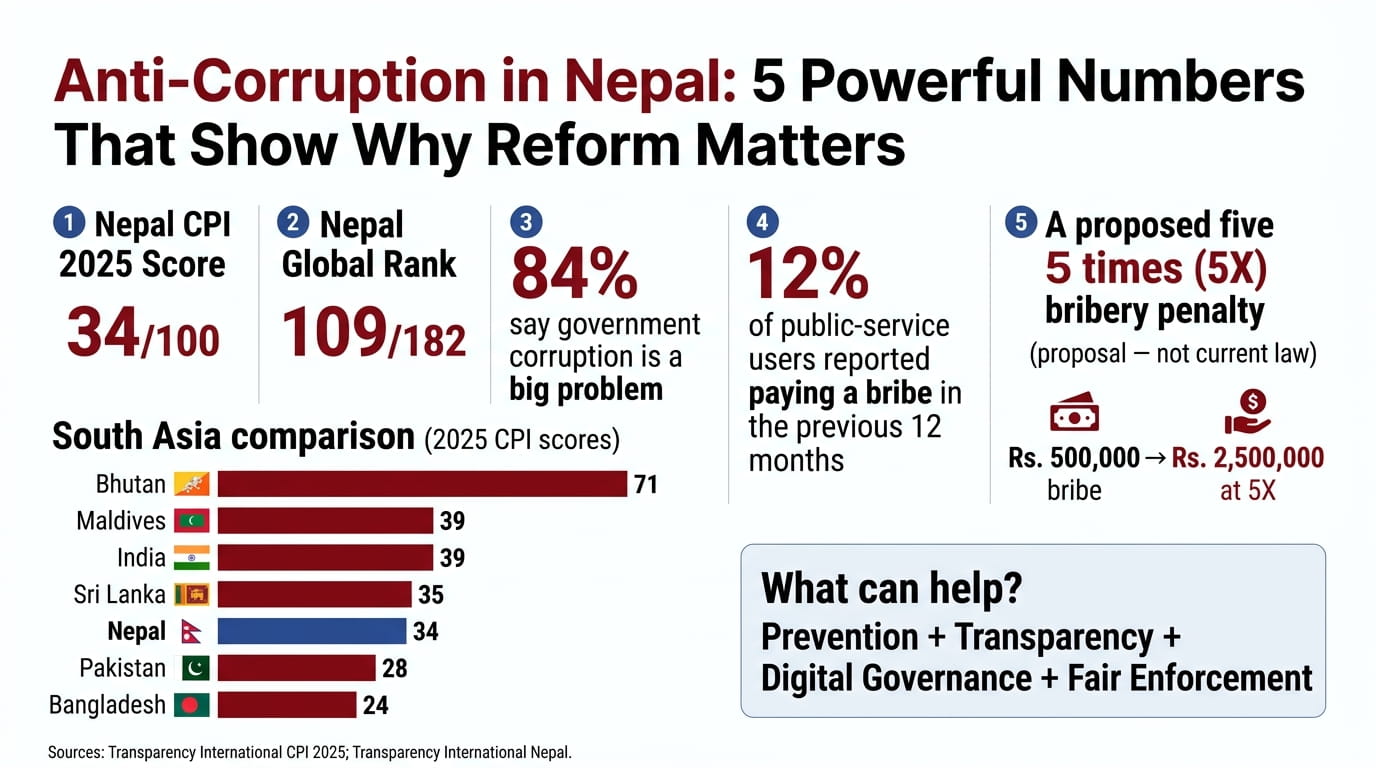
A recent proposal attributed to Commission for the Investigation of Abuse of Authority (CIAA) Chief Commissioner Prem Kumar Rai has attracted public attention: for smaller corruption cases, could Nepal consider a faster system in which a person found guilty of taking a bribe pays a penalty several times the amount involved and loses the job, rather than every relatively small case going through a lengthy process?
The idea is being discussed as a proposal, not as a rule already in force. Nepal’s existing Prevention of Corruption Act already provides criminal penalties and fines for bribery, including imprisonment according to the amount involved and confiscation of the bribe received.
That distinction matters.
Good governance should be built on facts, due process and equal treatment—not simply on powerful headlines.
But the bigger question remains:
Could a faster and more financially painful punishment make corruption a much less attractive choice?
At Bhuone, we believe this conversation deserves attention—not because punishment alone can solve everything, but because a healthy nation needs systems that reward honesty, protect public resources and make ordinary citizens feel respected.
And perhaps Nepal’s greatest opportunity is not only to punish corruption better, but to design systems where corruption becomes harder to commit in the first place.
Anti-Corruption in Nepal is ultimately about protecting the relationship between citizens and the state. When public institutions work transparently, people can access services with greater confidence. When corruption becomes normal, that confidence slowly disappears. For this reason, Anti-Corruption in Nepal should be viewed as a long-term national development priority rather than a temporary political issue.
A stronger approach to Anti-Corruption in Nepal can also support economic development. Businesses need predictable rules, entrepreneurs need fair opportunities and citizens need confidence that public resources are being managed responsibly. These are not separate goals. They are connected parts of a stronger Nepal.
Understanding Anti-Corruption in Nepal
Anti-Corruption in Nepal is much bigger than catching someone accepting cash.
It includes preventing bribery, protecting public resources, improving government transparency, strengthening accountability, reducing opportunities for abuse of authority and creating institutions where decisions can be trusted.
The CIAA is Nepal’s constitutional institution responsible for investigating abuse of authority and corruption in the public sector. Its own strategic material emphasizes investigation, prosecution, coordination and the importance of political commitment and institutional capacity in fighting corruption.
Nepal also has a specific legal framework through the Prevention of Corruption Act, 2059.
The existing law defines bribery broadly and covers both receiving and giving bribes. Section 3 establishes imprisonment according to the amount of the bribe, together with a fine corresponding to the amount involved, and provides for confiscation of a bribe already received.
For example, under the published Act:
- Bribes up to Rs. 25,000 can attract up to three months’ imprisonment.
- More than Rs. 25,000 to Rs. 50,000 can attract three to four months.
- More than Rs. 50,000 to Rs. 100,000 can attract four to six months.
- More than Rs. 100,000 to Rs. 500,000 can attract six months to one and a half years.
- Larger amounts carry progressively higher imprisonment.
- A bribe received can also be confiscated.
So Nepal is not starting from zero.
The real question is whether the implementation, speed, certainty and deterrent effect of the system are strong enough.
That is where the proposed discussion becomes interesting.
What Does “5X Penalty” Actually Mean?
The phrase “5X penalty” is easy to understand.
If a person were legally found responsible for taking Rs. 500,000 and a five-times financial penalty applied, the penalty would be Rs. 2.5 million.
But there is an important legal and policy question:
Would such a system replace existing criminal punishment, operate alongside it, or apply only to a narrowly defined class of minor cases?
That cannot be answered by a social-media post.
Any new mechanism would need legislation, clearly defined thresholds, procedural safeguards and judicial or legally authorized review.
The attractive part of the proposal is its simplicity.
The difficult part is making that simplicity fair.
Why Anti-Corruption in Nepal Matters Today
Corruption is not simply about money changing hands.
Its consequences can spread through an entire society.
When a citizen pays a bribe to obtain a service that should have been delivered fairly, the immediate loss is financial. But the deeper loss is trust.
People begin asking:
- Why follow the rules if others can pay to bypass them?
- Why wait in line if connections can move someone ahead?
- Why start a legitimate business if unofficial payments are expected?
- Why trust public institutions if decisions appear to depend on personal relationships?
- Why encourage young people to stay and build Nepal if merit does not appear to matter?
These questions affect the country’s social and economic foundations.
The importance of Anti-Corruption in Nepal goes beyond government offices and political institutions. It affects how citizens experience public services, how businesses compete, how development projects are implemented and how young people view their country’s future. Effective Anti-Corruption in Nepal therefore requires both stronger accountability and better systems for preventing corruption.
The economic importance of Anti-Corruption in Nepal is particularly significant for small businesses. Entrepreneurs often operate with limited capital and limited time. Unclear procedures or unofficial demands can increase their operating costs. Effective Anti-Corruption in Nepal measures can help create a more predictable environment for entrepreneurship and investment.
Social trust is another important part of Anti-Corruption in Nepal. A society becomes stronger when people believe that rules apply fairly. If citizens believe that money or connections can influence every decision, trust in institutions can decline. Building trust must therefore remain at the center of Anti-Corruption in Nepal.
1. Corruption Can Increase the Cost of Everyday Life
A bribe may look small to someone with authority.
But for a student, farmer, migrant worker’s family or small entrepreneur, even a few thousand rupees can matter.
The problem becomes worse when unofficial payments become normalized.
A citizen should not have to calculate an “extra cost” simply to receive a lawful public service.
2. Corruption Can Hurt Honest Businesses
Imagine two entrepreneurs competing for the same opportunity.
One invests in quality, workers, technology and compliance.
The other relies on influence and unofficial payments.
If the second approach consistently wins, the honest entrepreneur receives a dangerous message:
Integrity is expensive.
That is exactly the opposite of what a healthy economy needs.
Transparent competition encourages innovation. Corruption encourages connections.
3. Corruption Can Damage Public Projects
Nepal invests in roads, bridges, schools, hospitals, water systems, irrigation, digital services and other public infrastructure.
When procurement or implementation is distorted by corruption, the public may ultimately receive less value for the money spent.
A road that should last longer may require earlier maintenance.
A public building may cost more than necessary.
A service may become slower and more complicated.
The result is not only financial waste. It can also reduce confidence in development itself.
4. Corruption Is a Sustainability Issue Too
This is particularly important from the Bhuone perspective.
Sustainability is often discussed through soil, forests, water, climate and biodiversity.
But sustainability also depends on institutions.
A country cannot sustainably manage natural resources if decision-making is opaque.
Environmental regulations need fair enforcement.
Public projects need transparent procurement.
Community resources need accountable management.
Development needs trust.
That is why Anti-Corruption in Nepal belongs in the sustainability conversation.
A healthy ecosystem needs balance.
A healthy society does too.
The Big Question: Would a 5X Penalty Reduce Bribery?
Possibly—but only if the punishment is certain, timely and fairly applied.
A very high punishment written on paper does not automatically create deterrence.
Think about a simple equation:
Expected cost of corruption = probability of being caught × probability of being convicted × punishment
If the punishment is extremely high but the chance of detection or conviction is perceived as very low, the deterrent effect may still be weak.
This is why a five-times penalty by itself should not be treated as a magic solution.
The more powerful combination may be:
Detection + investigation + fair process + timely decision + meaningful punishment + transparency
That is where technology can become extremely important.
Modern Anti-Corruption in Nepal cannot depend only on traditional investigation. Digital records, transparent public databases, automated workflows and responsible artificial intelligence can help identify unusual activities earlier. Technology should support Anti-Corruption in Nepal by making public processes easier to monitor and harder to manipulate.
Anti-Corruption in Nepal and the Power of Technology
Technology cannot make an unethical person ethical.
But technology can reduce opportunities for hidden transactions.
This is where my background in IT, computing, automation and technology makes me especially interested in the anti-corruption conversation.
I have always believed that technology is most valuable when it solves a real human problem.
The same principle applies to governance.
1. Digital Government Services
The fewer unnecessary physical interactions a citizen needs for a standard service, the fewer opportunities there may be for informal bargaining.
Digital applications can provide:
- Online forms
- Digital payments
- Application tracking
- Appointment systems
- Automated notifications
- Document verification
- Digital receipts
Instead of asking someone, “Where is my file?”, a citizen can potentially see the status online.
That simple change can reduce uncertainty.
2. Digital Payment Records
Cash can be difficult to trace.
Digital transactions can create records.
This does not mean every digital transaction is automatically clean, nor does it eliminate corruption.
But transparent digital records can improve auditability when systems are properly designed and protected.
3. AI-Based Risk Detection
Artificial intelligence can potentially help institutions identify unusual patterns.
For example, a system could flag:
- Repeated approvals by the same official
- Unusual procurement prices
- Multiple contracts going to connected suppliers
- Abnormally fast or slow approvals
- Repeated amendments to contracts
- Unusual payment patterns
- Conflicts between declared and observed information
AI should not automatically declare someone guilty.
That would be dangerous.
Instead, AI can act as an early-warning and investigation-support tool.
Humans must remain responsible for evidence, investigation and legally valid decisions.
4. Automated Audit Trails
Imagine a public service system where every important action leaves a secure digital record:
Application received → officer assigned → document checked → decision made → payment processed → service delivered.
If someone changes a critical record, the system can record who changed it, when and why.
That creates accountability.
5. Open Government Data
Transparency becomes more powerful when citizens can actually understand public information.
Imagine a public dashboard showing:
- Project name
- Approved budget
- Contractor
- Start date
- Expected completion
- Payments released
- Project status
- Completion evidence
Citizens do not need to be software engineers to ask meaningful questions.
Technology can make those questions easier.
Anti-Corruption in Nepal: From Punishment to Prevention
One of the most important shifts Nepal can make is moving from a system that primarily reacts to corruption toward one that also prevents opportunities for corruption.
Consider a simple example.
If a government office requires five unnecessary signatures for a service, each additional step creates another interaction.
If the process can be reduced to one transparent digital workflow without compromising legal safeguards, the opportunity for informal influence may decrease.
This is not about removing human beings.
It is about removing unnecessary ambiguity.
A Practical Prevention Model
Nepal could increasingly focus on:
- Simplify procedures
- Digitize routine services
- Publish official fees clearly
- Provide application tracking
- Record decisions digitally
- Automate low-risk approvals
- Flag unusual patterns
- Protect whistleblowers
- Strengthen independent investigation
- Publish meaningful accountability data
The goal should be simple:
Make the honest path easier than the dishonest path.
One practical goal of Anti-Corruption in Nepal should be to make government services simple, transparent and predictable. When citizens clearly know the official fee, required documents and expected processing time, there is less room for confusion and informal demands. This makes Anti-Corruption in Nepal a practical governance issue rather than simply a punishment issue.
Practical Ways to Apply Anti-Corruption in Nepal
What can ordinary citizens do?
It is easy to believe that corruption is only the responsibility of politicians, civil servants or anti-corruption agencies.
It is not.
Citizens, businesses, professionals, journalists, technology developers and community organizations all have roles.
Step 1: Know the Official Process
Before paying anything unofficially, understand what the official service requires.
Look for:
- Required documents
- Official fees
- Processing time
- Responsible office
- Complaint mechanism
Knowledge reduces dependence on middlemen.
Step 2: Ask for Receipts
Whenever a legitimate government fee is paid, request an official receipt.
A receipt creates a record.
If someone asks for an unofficial payment, understand the distinction between an official fee and an informal demand.
Step 3: Use Digital Channels Where Available
Online applications and digital payments can reduce unnecessary physical interactions.
But use only official platforms.
Do not send money to an unknown personal account simply because someone claims it is necessary to “speed up” a process.
Step 4: Keep Evidence Responsibly
If you encounter suspected wrongdoing, preserve relevant documents or records where lawful and safe.
Do not fabricate evidence.
Do not publicly accuse someone without reliable information.
A responsible anti-corruption culture must protect innocent people from false accusations as well.
Step 5: Use Proper Complaint Channels
Nepal already has institutions designed to receive and investigate corruption-related complaints.
The CIAA is one of the country’s key constitutional institutions in this field. Its institutional material describes its role in investigating and prosecuting corruption and abuse of authority.
For official information, citizens should rely on the Commission for the Investigation of Abuse of Authority (CIAA) rather than social-media rumors.
Step 6: Businesses Should Build Internal Controls
Corruption prevention is not only a government issue.
Private businesses can establish:
- Approval limits
- Expense records
- Supplier verification
- Conflict-of-interest declarations
- Digital accounting
- Procurement rules
- Audit trails
A small company can start with a simple spreadsheet.
A larger company can implement enterprise systems.
The principle is the same:
Do not let one person control everything without accountability.
The Role of Citizens in Anti-Corruption in Nepal
A strong anti-corruption culture does not begin only inside government offices.
It begins with everyday choices.
If someone says:
“Give me a little extra and I will make it happen.”
The easy response may be to pay.
Sometimes people feel they have no alternative.
That is why reform must focus on the system, not simply blame individuals.
Citizens need safe, accessible and practical ways to complete legitimate processes without paying bribes.
At the same time, society should stop treating corruption as a clever shortcut.
A person who uses influence to bypass a queue is not necessarily “smart.”
They may simply be transferring inconvenience to someone else.
Challenges & Honest Limitations
No serious discussion of Anti-Corruption in Nepal should pretend that one policy will solve everything.
There are difficult questions.
Challenge 1: What Counts as a “Small” Case?
A threshold would need to be clearly defined.
Would Rs. 20,000 be considered small?
Rs. 100,000?
Rs. 500,000?
And should the same threshold apply across all circumstances?
A clear legal framework would be essential.
Challenge 2: Due Process Cannot Be Ignored
Speed is valuable.
But speed without fairness can become dangerous.
A person should not lose employment merely because an accusation has been made.
There must be reliable evidence, proper investigation and legally valid decision-making.
The objective should be:
Fast justice—not careless justice.
Challenge 3: What About False Complaints?
An aggressive anti-corruption system can itself be abused if safeguards are weak.
False complaints, political retaliation or personal disputes should not become tools for destroying someone’s career.
Anti-corruption institutions must therefore be strong and accountable.
Challenge 4: Selective Enforcement
Perhaps the most damaging scenario would be a system that punishes ordinary employees while powerful individuals escape scrutiny.
Citizens will lose faith if they see different standards for different people.
A credible system must apply the same principle regardless of:
- Position
- Wealth
- Political connection
- Family background
- Institution
- Geography
Equality before the rules is the foundation of trust.
Challenge 5: Technology Can Also Be Abused
Digital systems are not automatically transparent.
Data can be manipulated.
Algorithms can be biased.
Systems can be hacked.
Access controls can fail.
Therefore, digital governance needs cybersecurity, independent auditing, privacy protection and clear accountability.
Technology should make corruption harder—not simply make it digital.
Anti-Corruption in Nepal and the Future of AI
AI may become one of the most important tools in governance over the coming decade.
But I would make one principle very clear:
AI should assist accountability, not replace human judgment.
Imagine an AI system monitoring thousands of procurement records.
It notices that one supplier repeatedly wins contracts at prices significantly different from comparable purchases.
The system generates a risk alert.
A human auditor examines the documents.
Investigators collect evidence.
The responsible legal authority evaluates the case.
A court or legally authorized mechanism determines responsibility.
That is a healthy model.
AI detects patterns.
Humans investigate.
Law decides.
This separation matters.
The future of Anti-Corruption in Nepal could increasingly involve data-driven monitoring. AI can help identify unusual procurement patterns, repeated transactions or other risk indicators for human investigators to examine. Used responsibly, this approach could make Anti-Corruption in Nepal more preventive rather than purely reactive.
AI Could Help Build a More Transparent Nepal
Potential applications include:
- Procurement anomaly detection
- Automated financial reconciliation
- Public project monitoring
- Document verification
- Duplicate payment detection
- Risk scoring for audits
- Digital complaint categorization
- Service-delivery analytics
- Public spending visualization
These tools should be transparent enough to be audited.
People should also understand that an algorithmic flag is not proof of corruption.
That distinction protects both citizens and institutions.
Robotics, Automation and the Lesson From Smart Farming
Why does Bhuone, a platform associated with nature, sustainable farming and agro-technology, care about governance?
Because the same systems-thinking approach used in smart farming can apply to public administration.
In farming, we can use sensors to monitor:
- Soil moisture
- Water levels
- Temperature
- Plant growth
- Nutrient conditions
Instead of waiting until a crop fails, we try to identify problems earlier.
Governance can work similarly.
Instead of waiting for a large corruption scandal, institutions can build systems that identify unusual patterns early.
This is one reason I am interested in AI-driven sustainable farming in Nepal and responsible automation.
I see technology not as a replacement for people, but as a tool that helps people make better decisions.
Bhuone has explored this philosophy through practical discussions about AI, smart farming and sustainable systems.
The same philosophy can extend beyond agriculture.
Measure. Monitor. Understand. Improve.
Future Scope & Opportunities in Nepal
A stronger anti-corruption environment could create opportunities that are easy to overlook.
1. GovTech Jobs
Nepal’s young technology workforce could contribute to:
- Digital government platforms
- Cybersecurity
- Data analytics
- AI governance
- Digital identity systems
- Procurement monitoring
- Public dashboards
This could create meaningful technology careers inside and around the public sector.
2. Transparent Entrepreneurship
Entrepreneurs benefit from predictable systems.
If permits, registrations, taxes and procurement become clearer and more transparent, businesses can spend more energy on innovation rather than navigating uncertainty.
3. Youth Participation
Young Nepalis are increasingly comfortable with digital tools.
They can become:
- Civic technology developers
- Data analysts
- Investigative researchers
- Transparency advocates
- Ethical entrepreneurs
- Community educators
The future of governance should not be designed without young people.
Young Nepalis can play an important role in Anti-Corruption in Nepal by developing civic technology, promoting digital transparency and demanding accountable public services. The next generation should see Anti-Corruption in Nepal not merely as a government responsibility, but as a shared national responsibility.
4. Stronger Rural Services
Digital governance can be particularly valuable outside major cities.
A person living in a remote district should not have to travel repeatedly to Kathmandu for a routine administrative service if that service can safely be delivered online.
Reducing distance can reduce both cost and opportunity for informal influence.
5. Better Use of Public Money
Transparent procurement and monitoring can help society ask a simple question:
Are we receiving the value we paid for?
That question is fundamental to sustainable development.
Common Myths & Truths About Anti-Corruption in Nepal
Myth 1: “Higher punishment automatically ends corruption.”
Truth: Punishment matters, but certainty of detection, fair enforcement and institutional quality also matter.
Myth 2: “Only government officials are responsible.”
Truth: Bribery can involve both the person demanding and the person offering or facilitating an unlawful benefit. Nepal’s existing law addresses both sides of bribery.
Myth 3: “Technology will eliminate corruption.”
Truth: Technology can reduce opportunities and improve traceability, but humans design and operate systems.
Myth 4: “Digital means corruption-free.”
Truth: Digital corruption is still possible.
Fraud, manipulation, unauthorized access and conflicts of interest can move online.
Myth 5: “A five-times penalty is already Nepal’s law.”
Truth: The five-times idea discussed here should be understood as a proposal or policy suggestion, not as an enacted rule. Nepal’s current legal framework has its own bribery penalties.
Myth 6: “Anti-corruption is only about punishment.”
Truth: Prevention may be even more important.
Simpler processes, transparency, digital records, strong institutions and ethical leadership can reduce opportunities for corruption before a crime occurs.
What Nepal Can Learn From the Proposal
Whether the exact five-times formula becomes law is only one question.
The larger lesson is that Nepal needs to keep asking:
Can we make corruption less profitable, less convenient and more detectable?
That means looking at the complete system.
A Stronger Anti-Corruption Framework Could Include
1. Prevention
Design processes that reduce opportunities for bribery.
2. Transparency
Publish useful information in formats citizens can understand.
3. Technology
Create secure digital records and monitoring systems.
4. Detection
Use audits, data analysis and citizen reporting.
5. Investigation
Strengthen professional investigative capacity.
6. Due Process
Protect the rights of accused people while ensuring genuine cases are pursued.
7. Timely Decisions
Avoid unnecessary delays that weaken public confidence.
8. Meaningful Consequences
Ensure proven wrongdoing has consequences proportionate to the offence.
9. Equal Enforcement
Apply standards consistently.
10. Public Education
Teach citizens how official systems work and where to report suspected wrongdoing.
This is much bigger than one penalty.
It is an ecosystem.
Why Transparency Matters More Than Fear
Fear can change behavior temporarily.
Trust can change culture permanently.
A country should not aim for a society where people behave honestly only because they are afraid of punishment.
We should aim for a society where honesty is normal because:
- Rules are understandable.
- Institutions are trusted.
- Services are accessible.
- Officials are accountable.
- Businesses compete fairly.
- Citizens know their rights.
- Corruption is socially unacceptable.
- Public resources are treated as everyone’s resources.
That is a much more sustainable goal.
Bhuone Perspective: Technology + Nature + Humanity
At Bhuone, our philosophy has always been about connection.
Nature teaches us that every part of an ecosystem affects another.
A small change in water quality can affect fish.
A change in soil can affect crops.
A change in climate can affect an entire farming system.
Society works in a similar way.
A small act of corruption may appear isolated.
But when repeated thousands of times, it can influence business confidence, public services, infrastructure, employment, investment and people’s belief in their country.
That is why Anti-Corruption in Nepal should not be treated as a political slogan.
It should be treated as a national sustainability issue.
Bhuone’s wider philosophy connects technology with responsible living, sustainable agriculture, community knowledge and innovation. The platform describes its mission as bringing technology and nature together while promoting responsible, sustainable systems.
Our interest in AI, robotics and automation comes from the same place.
Technology should serve people.
It should reduce waste.
It should increase transparency.
It should empower communities.
And it should never become an excuse to remove human responsibility.
You can explore more about this philosophy through Bhuone’s articles on Sustainable Living in Nepal and AI-Driven Sustainable Farming in Nepal.
What Can Ordinary Nepalis Do Today?
We do not need to wait for a new law to become responsible citizens.
We can start with small actions.
Citizens
- Learn official procedures.
- Ask for official receipts.
- Avoid spreading unverified allegations.
- Report genuine concerns through appropriate channels.
- Support transparent public services.
Businesses
- Maintain accurate accounts.
- Separate personal and company expenses.
- Use documented procurement.
- Establish conflict-of-interest policies.
- Reject unofficial payments where safely possible.
Technology Professionals
- Build transparent systems.
- Protect user data.
- Design audit trails.
- Make public information understandable.
- Test algorithms for bias and abuse.
Young People
- Learn about civic systems.
- Question misinformation.
- Participate constructively.
- Build GovTech solutions.
- Use technology for accountability rather than online harassment.
Media and Content Creators
- Verify before publishing.
- Distinguish allegations from proven facts.
- Avoid sensational accusations.
- Explain complicated policies in simple language.
- Give citizens useful context.
This is how a culture changes.
Not overnight.
But consistently.
Could the 5X Proposal Become a Turning Point?
That depends on what happens next.
If the idea remains only a headline, its impact will be limited.
If it becomes part of a carefully designed legal and institutional reform process, it could contribute to a broader discussion about how Nepal handles smaller corruption cases.
But the five-times figure should not distract us from the bigger reform questions.
We should ask:
Will cases be investigated fairly?
Will powerful and ordinary people face the same standards?
Will decisions happen faster without sacrificing due process?
Will stolen public resources be recovered?
Will technology improve transparency?
Will citizens have easier access to services without middlemen?
Will prevention receive as much attention as punishment?
Those questions are more important than the number five itself.
A Hopeful Future for Anti-Corruption in Nepal
Nepal has enormous potential.
We have young people who understand technology.
We have entrepreneurs building new businesses.
We have farmers experimenting with modern agriculture.
We have communities protecting local resources.
We have engineers, researchers, journalists, civil servants and citizens who want better systems.
The challenge is connecting these strengths.
Imagine a Nepal where a citizen can apply for a service from a phone.
The official fee is clearly displayed.
The application receives a digital tracking number.
The responsible office is visible.
Every major action creates an audit trail.
An AI system can identify unusual patterns for human review.
An independent institution investigates credible complaints.
A fair legal process determines responsibility.
Public spending can be examined by citizens.
And honest businesses compete based on quality—not connections.
That is not a fantasy.
Parts of such a system already exist in different forms around the world.
The opportunity for Nepal is to build systems appropriate to our own geography, institutions, culture and resources.
Ultimately, Anti-Corruption in Nepal is about building trust. Strong laws matter, but so do transparent institutions, responsible technology, fair enforcement and citizens who understand their rights. A successful Anti-Corruption in Nepal strategy should make honest behavior easier and corruption increasingly difficult.
Conclusion: Make Honesty Easier
The discussion around Anti-Corruption in Nepal and the proposed five-times bribery penalty is important because it forces us to ask an uncomfortable but necessary question:
What would actually make corruption a bad decision?
A large fine may help.
Job loss may help.
Faster decisions may help.
Technology may help.
But none of these works perfectly alone.
The strongest solution is an ecosystem of prevention, transparency, detection, fair investigation, timely justice, meaningful consequences and responsible technology.
Nepal does not need only stronger punishment.
Nepal needs stronger systems.
And stronger systems begin with something surprisingly simple:
Make the honest path easier.
Make the rules clearer.
Make public information accessible.
Make transactions traceable.
Make institutions accountable.
And make technology serve people rather than power.
The proposed 5X penalty may or may not become part of Nepal’s future legal framework. What matters today is that the conversation has opened a door.
Let us use that door wisely.
Let us build a Nepal where a young entrepreneur can start a business without fear of hidden payments.
Where a farmer can access public services without depending on connections.
Where a student believes merit matters.
Where a government employee can do the right thing without pressure.
Where public money is treated as public trust.
And where technology, nature and humanity grow together.
That is the Nepal Bhuone hopes to see. 🌱
Social Links
For readers who want to continue the conversation, Bhuone also shares ideas and community discussions through its social platforms:
Sources & Fact-Checking Notes
Nepal’s Prevention of Corruption Act, 2059 is the key legal reference for the current bribery framework, including amount-based imprisonment, fines and confiscation of bribes.
The CIAA’s institutional strategy identifies investigation, prosecution, coordination, institutional capacity and political commitment as important components of corruption control.
For the article’s central 5X proposal, the wording should remain “proposal,” “suggestion,” or “idea under discussion” unless and until an authoritative primary source confirms that a new rule has actually been enacted. This is especially important for an AdSense-friendly, trust-focused publication.
Bhuone’s own published philosophy emphasizes the intersection of technology, nature, sustainable living, AI and community-oriented innovation.