

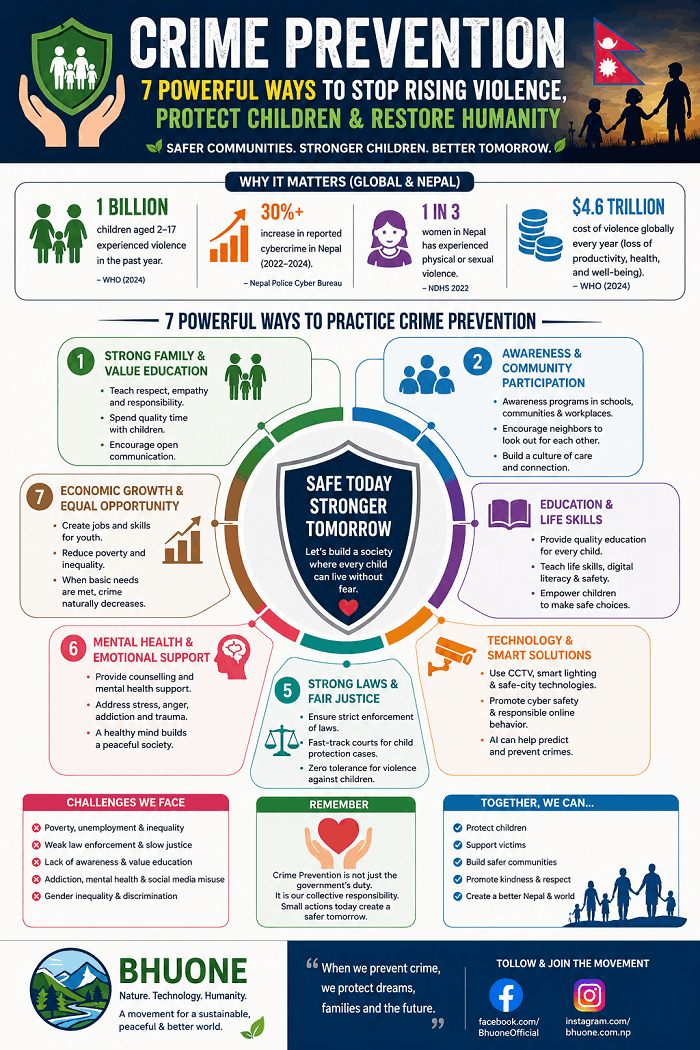
Crime Prevention: 7 Powerful Ways to Stop Rising Violence, Protect Children & Restore Humanity
There are moments when a community stops scrolling, stops talking about politics, and simply asks one painful question: How did we allow this to happen?
When an innocent child becomes a victim of violence, the pain goes far beyond one family. It shakes parents, teachers, neighbours and an entire community. It forces us to think about safety, responsibility, social values, law enforcement and, most importantly, our humanity.
For Bhuone, Crime Prevention is not only about what happens after a crime. It is about asking what we can do before violence happens.
Nepal, like every society, needs justice when crimes occur. But justice after tragedy cannot be the only answer. We also need safer communities, responsible parenting, stronger child-protection systems, better education, ethical technology and citizens who refuse to remain silent when they see warning signs.
The good news is that violence is not inevitable. Evidence from international organizations shows that violence against children can be prevented through coordinated action at individual, family, community and societal levels.
That means prevention is possible.
And prevention begins with us.
Understanding Crime Prevention in Nepal
Crime Prevention means taking practical steps to reduce the conditions, opportunities and behaviours that can lead to crime.
It does not mean predicting that a particular person will become a criminal. It means building environments where:
- children are safer,
- families know where to seek help,
- communities notice risks early,
- schools teach respect and responsibility,
- public spaces are designed with safety in mind,
- technology is used responsibly,
- institutions respond effectively,
- and citizens understand that silence can allow harmful behaviour to continue.
This is particularly important for children.
UNICEF Nepal identifies violence, exploitation, abuse, child marriage, child labour, trafficking and gaps in child-friendly justice among important child-protection concerns in Nepal. It also notes that violence against children remains significantly underreported.
That last point deserves serious attention.
A crime that is never reported can become a hidden pattern.
A warning sign that nobody discusses can become a bigger danger.
A child who is afraid to speak may remain vulnerable.
A neighbour who sees something concerning but decides, “It is not my problem,” may unintentionally allow a dangerous situation to continue.
This is why Crime Prevention is a community responsibility, not simply a police responsibility.
Crime Prevention starts before the crime
There is a common misunderstanding that preventing crime means simply increasing punishment.
Punishment matters when a crime has been established through due process. But prevention is broader.
It asks:
Why did the risk exist?
Could somebody have noticed the warning signs earlier?
Was the child adequately protected?
Was the environment safe?
Did people know how to report concerns?
Were institutions prepared to respond?
These questions do not replace justice. They strengthen it.
Why Crime Prevention Matters Today
The world is experiencing rapidly changing social and technological environments.
Children spend time both offline and online. Communities are becoming more urban. Families may be separated by migration. Social relationships are changing. Digital platforms can connect people—but they can also create new forms of harassment, exploitation and abuse.
WHO estimates that up to 1 billion children aged 2–17 experienced physical, sexual or emotional violence or neglect in the previous year. WHO also emphasizes that violence against children is preventable.
According to the World Health Organization’s violence-against-children data, up to 1 billion children aged 2–17 experienced physical, sexual or emotional violence or neglect in the previous year.
This is not simply a statistic.
Behind every number is a human being.
A child.
A parent.
A teacher.
A family.
A future that could have been different.
The Nepal connection
UNICEF Nepal reports that almost every child aged 1–14 in Nepal experiences some form of violent discipline at home, with 82% of children affected, according to the data presented on its child-protection page. UNICEF also identifies child labour, trafficking, child marriage and insufficient access to child-friendly justice as continuing concerns.
According to UNICEF Nepal’s child protection information, violence, exploitation, abuse, child marriage, child labour, trafficking and gaps in child-friendly justice remain important child-protection concerns in Nepal.
These figures should not make us hopeless.
They should make us more determined.
Because prevention does not begin with complicated technology or massive government budgets.
It can begin with something as simple as teaching a child:
“If someone makes you uncomfortable, you can tell me.”
It can begin with a parent learning non-violent discipline.
It can begin with a teacher taking a child’s concern seriously.
It can begin with a neighbour knowing how to report a genuine safety concern.
It can begin with a community making children feel that adults are there to protect them.
Crime Prevention Is Also About Restoring Humanity
There is another part of the conversation that statistics cannot fully capture.
Humanity.
Our grandparents and parents often emphasized respect for elders, kindness toward younger people, hospitality toward neighbours and responsibility toward the wider community.
Modern life has brought enormous benefits. But rapid change can sometimes weaken community relationships.
People can live in the same neighbourhood without knowing each other.
Children can spend hours with digital devices but have fewer meaningful conversations with adults.
People can become connected online while becoming disconnected emotionally.
And public discussion can become increasingly aggressive.
We should be careful not to claim that declining manners directly cause serious crimes. Crime is complex. Violence has multiple causes, and different forms of crime require different prevention approaches.
But respectful relationships, emotional skills, positive parenting and healthy communities are important protective factors.
WHO’s prevention framework similarly emphasizes action across individual, relationship, community and societal levels.
So Crime Prevention is not only about cameras, police vehicles and punishment.
It is also about building a society where people value human life.
7 Powerful Ways Crime Prevention Can Stop Rising Violence
1. Crime Prevention Starts With Strong Families and Safe Conversations
A child’s first safety system is often the family.
Children need adults they can approach without fear.
This does not mean parents should create fear-based environments where children obey every instruction without question. Quite the opposite.
A safer family environment allows children to ask questions, describe uncomfortable situations and speak about things they do not understand.
Teach children simple safety principles
Parents and caregivers can teach age-appropriate ideas such as:
- Your body belongs to you.
- You can say no to inappropriate touch.
- You should tell a trusted adult if something feels wrong.
- Secrets that make you frightened or uncomfortable should be shared with a trusted adult.
- You do not have to protect an adult’s secret if you feel unsafe.
- If one adult does not listen, tell another trusted adult.
- Online strangers are still strangers.
- Never meet an online contact alone.
The goal is not to make children afraid of the world.
The goal is to make children confident enough to ask for help.
Positive parenting matters
Violence should not be normalized as discipline.
Children learn from what adults demonstrate.
If adults solve every disagreement through shouting, humiliation or physical aggression, children can learn that power is expressed through violence.
WHO identifies positive parenting, non-violent discipline and skills development among approaches that can help prevent violence against children.
A safer home therefore becomes an important part of Crime Prevention.
2. Crime Prevention Needs Safer Schools and Communities
Schools are more than places for academic learning.
They are social environments where children learn how to communicate, cooperate, resolve conflict and understand boundaries.
A strong Crime Prevention approach should therefore include safety education.
Schools can teach:
- respect and consent,
- digital citizenship,
- bullying prevention,
- conflict resolution,
- emotional awareness,
- responsible technology use,
- how to report unsafe behaviour,
- emergency preparedness,
- respect for differences.
Schools should also have clear procedures for responding to concerns.
A child should know:
Who can I tell?
Where can I go?
What happens after I report something?
Will adults listen to me?
WHO’s school-based violence-prevention guidance emphasizes evidence-informed approaches to reducing violence and supporting safer learning environments.
Communities matter too
Imagine a neighbourhood where:
- street lighting works,
- unsafe abandoned spaces are identified,
- children have safe routes to school,
- adults know local safeguarding procedures,
- community leaders cooperate with authorities,
- suspicious or dangerous situations can be reported appropriately,
- and people look after one another.
That is Crime Prevention in practice.
It is not glamorous.
It is simply responsible.
3. Crime Prevention Requires Better Reporting and Early Intervention
One of the most difficult parts of preventing violence is knowing when to act.
Sometimes people notice something concerning but hesitate.
They think:
“Maybe I misunderstood.”
“It is a family matter.”
“Someone else will report it.”
“I don’t want trouble.”
That hesitation can be dangerous when a genuine risk exists.
At the same time, responsible Crime Prevention does not mean accusing people without evidence.
We need a balanced approach:
Notice → assess → document where appropriate → report through proper channels → allow trained authorities to investigate.
Do not take the law into your own hands.
Do not publicly identify or threaten suspects.
Do not spread unverified accusations.
Do not circulate graphic material involving victims.
Instead, use legitimate reporting mechanisms and protect the dignity and privacy of victims.
UNICEF Nepal notes that reporting and referral mechanisms for child-protection concerns remain inadequate in some contexts, which highlights the importance of strengthening systems rather than relying only on individual action.
Early intervention can change outcomes
If a child is repeatedly bullied, early intervention may prevent escalation.
If a teenager shows serious behavioural problems, supportive intervention may help.
If a family is under severe stress, access to social services can reduce risk.
If a community identifies a dangerous physical environment, fixing it may prevent an incident.
Crime Prevention works best when intervention happens before the situation becomes irreversible.
4. Crime Prevention Must Include Responsible Technology
Technology is neither automatically good nor automatically bad.
It depends on how humans design and use it.
This is where Bhuone’s philosophy becomes important.
With a background in computing, software development and interest in AI, robotics and automation, I see technology as a tool.
A powerful tool.
But still a tool.
Technology should serve humanity—not replace humanity.
Smart technology can support safer communities
Depending on local laws, resources and privacy safeguards, technology can help with:
- emergency communication,
- community alerts,
- secure reporting systems,
- location-based safety information,
- public-space lighting management,
- access control,
- cybersecurity,
- digital evidence management,
- safety education,
- data analysis,
- emergency response coordination.
But technology must be implemented responsibly.
A camera does not automatically create safety.
An AI system does not automatically understand human context.
A database does not automatically protect a child.
Human judgment remains essential.
AI and Crime Prevention
AI can potentially help institutions analyze large datasets, identify patterns, support investigations and improve resource allocation.
Recent UN discussions on crime prevention and criminal justice have specifically recognized potential positive uses of AI, including crime prevention and investigation involving crimes against children. At the same time, the same UN material emphasizes human oversight, privacy, accountability and safeguards.
That balance is critical.
AI should not become an excuse for uncontrolled surveillance.
We need:
AI + human oversight + privacy + accountability.
Not:
AI = automatic truth.
5. Crime Prevention Needs Digital Safety for Children
The physical world is not the only place where children need protection.
The internet has become part of childhood.
Children use:
- social media,
- messaging applications,
- online games,
- video platforms,
- educational websites,
- AI tools,
- digital communities.
These platforms can provide learning and connection.
But children can also encounter:
- cyberbullying,
- manipulation,
- inappropriate content,
- impersonation,
- scams,
- privacy violations,
- grooming attempts,
- harmful communities.
Parents should not respond by simply saying:
“Never use the internet.”
That is increasingly unrealistic.
Instead, we need digital literacy.
A practical digital safety routine
Parents can:
- Talk openly about online experiences.
- Teach children not to share sensitive personal information.
- Encourage strong, unique passwords.
- Use privacy settings appropriate to the child’s age.
- Explain that online identities may not be genuine.
- Teach children not to meet online contacts alone.
- Encourage children to save evidence of serious harassment.
- Explain how to block and report harmful accounts.
- Establish reasonable screen and device rules.
- Make sure children know they will not be punished for asking for help.
The goal is guided independence, not digital fear.
UNICEF Nepal also highlights online child safety as part of the broader child-protection landscape.
6. Crime Prevention Requires Better Data, Not Just More Opinions
When a serious incident happens, social media quickly fills with speculation.
One person shares a claim.
Another person copies it.
A third person adds a detail.
Soon, nobody knows what is verified.
This can harm investigations and victims.
A modern Crime Prevention system should be based on reliable data.
What should communities and institutions measure?
Depending on privacy and legal requirements, useful information can include:
- location patterns of reported incidents,
- time patterns,
- types of offences,
- age-related vulnerability patterns,
- repeat locations,
- response times,
- reporting rates,
- community safety concerns,
- gaps in services.
The purpose is not to create fear.
It is to understand where prevention resources are needed.
WHO maintains global violence datasets covering areas such as homicide and violence against children, illustrating how systematic data can support understanding of violence patterns.
Data must respect people
Data collection must never become an excuse to expose victims.
Especially with children, privacy matters enormously.
We should avoid:
- publishing a child’s identifiable photographs,
- sharing private family details,
- spreading graphic images,
- revealing sensitive locations,
- naming unverified suspects,
- circulating private documents.
A victim is a human being, not content.
That principle should guide responsible journalism, social media and community communication.
7. Crime Prevention Needs a Culture of Responsibility
This may be the most difficult step.
Because technology can be purchased.
Streetlights can be installed.
Software can be developed.
Policies can be written.
But responsibility must be cultivated.
Crime Prevention becomes stronger when people stop thinking:
“Someone else will handle it.”
And start thinking:
“What can I responsibly do to make my community safer?”
That does not mean becoming a vigilante.
It means becoming a responsible citizen.
A responsible community member can:
- listen to children,
- challenge harmful stereotypes,
- report genuine safety concerns,
- discourage bullying,
- protect victims’ privacy,
- avoid spreading rumours,
- support vulnerable families,
- teach children digital safety,
- participate in community awareness,
- cooperate with legitimate authorities,
- promote respectful communication.
Small actions create social norms.
And social norms influence behaviour.
Why Crime Prevention Is a Social, Environmental and Economic Issue
At first glance, Crime Prevention might appear unrelated to sustainability.
At Bhuone, we see a deeper connection.
A sustainable society is not only one with clean water and healthy soil.
It is also a society where people can live with dignity and security.
Social sustainability
A community cannot remain healthy if fear becomes normal.
Parents need confidence that children can learn and play safely.
Young people need constructive opportunities.
Elderly people need dignity.
Women and girls need freedom from violence.
Communities need trust.
These are forms of social sustainability.
Economic sustainability
Crime also creates economic pressure.
Families may lose income.
Businesses may invest more in security.
Communities may experience reduced trust.
Public institutions may spend resources responding to preventable problems.
Prevention can therefore be more than a moral responsibility.
It can also be part of long-term resilience.
Environmental connection
Even physical environments influence safety.
Poorly maintained public spaces, abandoned structures, inadequate lighting and unsafe pathways can create conditions where people feel vulnerable.
This does not mean the environment causes crime by itself.
Crime is complex.
But responsible urban design can contribute to safer public spaces.
A greener, better-maintained neighbourhood can also become a more connected neighbourhood.
That is where sustainability and Crime Prevention meet.
Role of Technology, AI & Innovation in Crime Prevention
Technology should not be introduced simply because it is fashionable.
Every tool should answer a human question:
What problem are we solving?
For Crime Prevention, possible applications include:
AI-assisted data analysis
Large amounts of anonymized incident data can be analyzed to understand patterns and allocate resources.
Smart public infrastructure
Sensors and connected systems can help monitor lighting, infrastructure failures and emergency conditions.
Emergency communication
Digital platforms can help communities receive verified alerts and information.
Child-safety education
Interactive learning tools can teach children safety concepts in age-appropriate ways.
Cybersecurity
As more public services become digital, protecting systems from cyber threats becomes part of community safety.
Robotics
Robotics could support dangerous inspection tasks, emergency assessment or infrastructure monitoring in appropriate situations.
But none of these should be presented as magical solutions.
UNODC has also warned that AI is being used by criminals for cybercrime and other harmful activities, meaning technology can create new risks while helping address old ones.
This is one of the biggest lessons of the AI era:
The same technology can empower protection or amplify harm.
Therefore, responsible innovation matters.
The same principle applies to sustainable development, where AI and automation can help solve practical problems when technology is designed around people and nature. We explore this approach in our article on AI-Driven Sustainable Farming in Nepal
Practical Ways to Apply Crime Prevention in Nepal
Crime Prevention does not have to start with a national mega-project.
It can start at the household and ward level.
For parents
- Have regular safety conversations with children.
- Know who your children spend time with.
- Teach body boundaries.
- Teach online safety.
- Listen without immediately judging.
- Know trusted reporting and support channels.
- Avoid violent discipline.
For schools
- Create clear safeguarding procedures.
- Train teachers to recognize warning signs.
- Teach respectful relationships.
- Establish confidential reporting pathways.
- Address bullying early.
- Teach digital citizenship.
For communities
- Identify unsafe physical spaces.
- Improve lighting where appropriate.
- Build neighbourhood communication networks.
- Protect victims’ privacy.
- Avoid rumours.
- Encourage responsible reporting.
- Work with local institutions.
For young people
Young people are not only beneficiaries of Crime Prevention.
They can be leaders.
They can:
- challenge bullying,
- promote respectful online behaviour,
- create awareness campaigns,
- develop safety technologies,
- volunteer in community projects,
- learn cybersecurity,
- participate in civic initiatives.
This is where Nepal’s young population can become one of its greatest strengths.
Challenges & Honest Limitations
A responsible article about Crime Prevention must also acknowledge what prevention cannot do.
There is no single formula that can eliminate every crime.
Crime has many causes.
They can include individual behaviour, family circumstances, social conditions, inequality, substance misuse, exploitation, organized crime, online risks, institutional weaknesses and many other factors.
Therefore, we should avoid simplistic statements such as:
“One law will solve everything.”
Or:
“One camera will stop crime.”
Or:
“Technology will make everyone safe.”
Reality is more complicated.
Privacy is a serious issue
Surveillance technologies can create safety benefits, but excessive surveillance can undermine privacy.
AI can make mistakes
Algorithms can reflect biased or incomplete data.
Communities have limited resources
A rural municipality may not have the same technology or workforce as a large city.
Reporting can be difficult
People may fear stigma, retaliation or social pressure.
Prevention takes time
Changing social attitudes does not happen overnight.
These limitations are not reasons to give up.
They are reasons to design better systems.
Future Scope & Opportunities for Nepal
Nepal has an opportunity to develop a distinctly human-centered model of Crime Prevention.
We do not have to copy every system from wealthy countries.
We can build solutions suited to our own communities.
Youth-led safety innovation
Imagine students developing:
- community safety applications,
- emergency communication tools,
- child-friendly reporting interfaces,
- cybersecurity education,
- AI-assisted public-service tools,
- smart lighting systems,
- accessible safety dashboards.
Technology education could become civic education.
Local innovation
Nepal has a strong culture of improvisation.
We often solve problems using limited resources.
That mindset can support low-cost safety innovation.
A simple digital reporting system that actually works may be more valuable than an expensive platform nobody uses.
Rural opportunities
Crime Prevention should not become Kathmandu-centric.
Remote communities also need:
- awareness,
- communication,
- trained personnel,
- child-protection systems,
- safe schools,
- reliable reporting pathways.
Digital connectivity can help bridge some geographical barriers, but local human networks remain essential.
Ethical AI jobs
The future may create opportunities in:
- AI ethics,
- cybersecurity,
- data governance,
- responsible automation,
- digital forensics,
- safety technology,
- public-sector technology,
- privacy engineering.
This is where Nepal’s technology talent can contribute globally.
Common Crime Prevention Myths & Truths
Myth 1: “Crime Prevention means harsher punishment.”
Truth: Punishment is one part of justice. Prevention also involves reducing risks, improving communities, supporting families, strengthening institutions and addressing early warning signs.
Myth 2: “Children should simply be taught to stay away from strangers.”
Truth: Child safety education needs to be broader than stranger danger. Children should understand boundaries, trusted adults, online risks and how to seek help.
Myth 3: “More cameras automatically mean less crime.”
Truth: Cameras can be useful in specific contexts, but technology alone cannot replace trained people, good procedures and community trust.
Myth 4: “AI can identify criminals before they commit crimes.”
Truth: That idea is far more complicated and risky than it sounds. AI systems can make errors and raise serious privacy and fairness concerns. Responsible AI requires human oversight and safeguards.
Myth 5: “Talking about crime creates fear.”
Truth: Sensationalizing crime can create fear. Responsible education can create awareness and preparedness.
Myth 6: “Crime Prevention is only the government’s responsibility.”
Truth: Government has major responsibilities, but families, schools, communities, technology companies, civil society and citizens all have roles.
Bhuone Perspective: Crime Prevention Through Nature, Technology & Humanity
Bhuone began from a simple idea:
Technology should serve life.
That idea started with nature.
Plants do not compete through noise.
Ecosystems survive through relationships.
Water moves through systems.
Fish and plants can support each other in aquaponics.
A farm becomes resilient when different elements work together.
Human society is also a system.
When families, schools, communities, institutions and technology work responsibly together, society becomes stronger.
When each part operates alone, weaknesses appear.
This is why Bhuone does not see technology as separate from humanity.
My journey through computing, software development, automation and sustainable farming has repeatedly taught me the same lesson:
A powerful system without responsibility can create powerful problems.
AI can be powerful.
Robotics can be powerful.
Automation can be powerful.
Data can be powerful.
But humanity must remain more powerful.
Technology should help us notice problems earlier.
It should help communities communicate.
It should help institutions work more efficiently.
It should help protect children.
It should help people make better decisions.
But it should never replace empathy.
That is the Bhuone way.
Nature + Technology + Humanity.
Not technology against nature.
Not technology above humanity.
Technology with humanity.
For readers interested in this broader philosophy, Bhuone’s discussion of technology reconnecting with nature explores the same principle from a sustainability perspective.
And our work on AI-driven sustainable systems explores how technology can be used responsibly rather than simply chasing automation for its own sake.
From Silent Observers to Responsible Citizens
One of the most uncomfortable questions we can ask ourselves is:
What would I do if I noticed something wrong?
Would I ignore it?
Would I record it for social media?
Would I gossip about it?
Or would I responsibly seek help?
There is a major difference between awareness and spectacle.
A tragedy should never become entertainment.
A victim should never become viral content.
A child’s photograph should never be treated as engagement bait.
A grieving family deserves dignity.
Responsible Crime Prevention therefore includes responsible communication.
Before sharing something online, ask:
- Is it verified?
- Could it harm a victim?
- Does it expose private information?
- Does it help prevent harm?
- Am I sharing facts or speculation?
- Is there a legitimate reason to publish it?
Sometimes the most responsible action online is simply:
Do not share it.
What Parents Can Do Today
You do not need to wait for a government programme.
Tonight, sit with your child.
Talk.
Ask:
“Do you feel safe at school?”
“Is there anyone who makes you uncomfortable?”
“Has anyone asked you to keep a secret that frightened you?”
“Do you know who you can call if you need help?”
For younger children, use simple language.
For teenagers, include online safety, relationships, privacy and peer pressure.
Most importantly:
Listen.
Sometimes children do not need a lecture.
They need an adult who will believe that their feelings matter.
What Communities Can Do This Month
A community can begin with a simple Crime Prevention checklist:
- Identify unsafe public areas.
- Discuss child safety with schools.
- Promote responsible reporting.
- Create awareness about online safety.
- Encourage respectful communication.
- Discourage victim-blaming.
- Protect victims’ identities and dignity.
- Build communication between community leaders and relevant authorities.
- Encourage youth participation.
- Review what worked and what did not.
None of these actions is revolutionary.
That is exactly why they matter.
Real change often begins with ordinary people doing ordinary things consistently.
A Note About Justice
When a serious crime occurs, people naturally demand justice.
That emotion is understandable.
Families deserve truth.
Victims deserve dignity.
Investigations deserve seriousness.
And where wrongdoing is proven through due process, appropriate legal consequences should follow.
But Crime Prevention asks us to go one step further.
After justice is pursued, we must ask:
How do we reduce the possibility of another family experiencing the same pain?
That question should remain even after public attention disappears.
Because prevention is measured not only by what we say after tragedy.
It is measured by what we build before the next tragedy.
Bhuone’s Call: Stop Crime Before It Starts
Bhuone is not here simply to publish another emotional message after another painful event.
The larger purpose is awareness.
We want to encourage a culture where people think before they act, where children are heard, where technology is used responsibly, where communities cooperate, and where nature and humanity remain central to progress.
The world does not need more outrage alone.
It needs responsible action.
Nepal does not need technology for technology’s sake.
It needs technology that solves real problems.
It does not need endless arguments about whether tradition or modernity is better.
It needs the best values from both:
the wisdom of our ancestors + the tools of our future.
Respect.
Compassion.
Responsibility.
Courage.
Education.
Innovation.
Justice.
Humanity.
These are not old-fashioned ideas.
They are foundations for a safer future.
Connect With Bhuone
If you believe that technology should serve people and that sustainability must include human responsibility, join the conversation.
Follow Bhuone on:
- Facebook: Bhuone Official on Facebook
- Instagram: Bhuone on Instagram
You can also explore Bhuone’s wider philosophy through our article on Sustainable Living in Nepal, which connects community responsibility, technology, nature and everyday action.
Conclusion: Crime Prevention Is Everyone’s Responsibility
Crime Prevention begins long before a police report.
It begins in a home where children are allowed to speak.
It begins in a school where bullying is taken seriously.
It begins in a community where people look after one another.
It begins in a society that refuses to normalize violence.
It begins with responsible technology.
It begins with accurate information.
It begins with institutions willing to learn from failures.
And it begins with ordinary citizens deciding that silence is not the only option.
We cannot promise that every crime can be prevented.
But we can build better systems.
We can educate.
We can listen.
We can report responsibly.
We can protect privacy.
We can design safer communities.
We can develop ethical technology.
We can teach our children compassion and boundaries.
We can use AI without surrendering human judgment.
We can preserve the values that made our communities caring while embracing the technology that can make them smarter.
Most importantly, we can refuse to become numb.
Every child deserves to grow up with dignity.
Every family deserves to feel safe.
Every community deserves hope.
And every generation has a responsibility to leave behind a society that is kinder, safer and more humane than the one it inherited.
That is the deeper meaning of Crime Prevention.
Not simply preventing crime.
Preventing the loss of humanity that allows violence to become normal.
🌱 Grow nature. Grow awareness. Grow humanity.
— Bhuone
Data & Evidence Used
- WHO estimates that up to 1 billion children aged 2–17 experienced physical, sexual or emotional violence or neglect in the previous year, and states that violence against children can be prevented.
- UNICEF Nepal reports that 82% of children aged 1–14 experience violent discipline, according to the child-protection information published by its Nepal programme.
- UNICEF Nepal identifies child marriage, child labour, trafficking, violence and gaps in child-friendly justice among continuing child-protection concerns in Nepal.
- WHO’s INSPIRE framework identifies seven evidence-based strategies for preventing violence against children, with action across multiple levels of society.
- UN material on AI and crime prevention emphasizes both the potential of AI and the need for human oversight, privacy and accountability.