
Mimosa Pudica Health Benefits: 10 Amazing Uses, Science & Safety Guide
Imagine walking through a quiet village trail in Nepal during the monsoon. You accidentally touch a small green plant, and within seconds its leaves gently fold inward as if it were alive and shy. Many of us have experienced this magical moment as children without ever knowing that this fascinating plant has been valued in traditional medicine for centuries.
Known locally by different regional names and globally as the Sensitive Plant or Touch-Me-Not, Mimosa pudica is much more than a botanical curiosity. Researchers, herbal practitioners, and natural health enthusiasts continue exploring Mimosa Pudica Health Benefits, hoping to better understand its medicinal compounds and traditional applications.
Across Nepal, where medicinal herbs have always been part of everyday life, people are rediscovering native and natural remedies while also demanding scientific evidence behind traditional knowledge. This balanced approach is more important than ever. While modern medicine remains essential, nature continues to inspire researchers to discover new therapeutic compounds that may improve human well-being.
At BhuOne, we believe that the future is not about choosing between nature and technology. It is about allowing science to validate traditional wisdom while using innovation to protect biodiversity and create sustainable livelihoods.
This guide explores what science currently knows, what traditional medicine has practiced for generations, and how Nepal can responsibly benefit from this remarkable plant.
Understanding Mimosa Pudica Health Benefits in Nepal
For many Nepalis, Mimosa pudica is simply the little plant that closes its leaves when touched. Children often play with it during walks through fields, roadsides, and forests. Yet beneath its delicate appearance lies a plant rich in bioactive compounds that has attracted scientific attention worldwide.
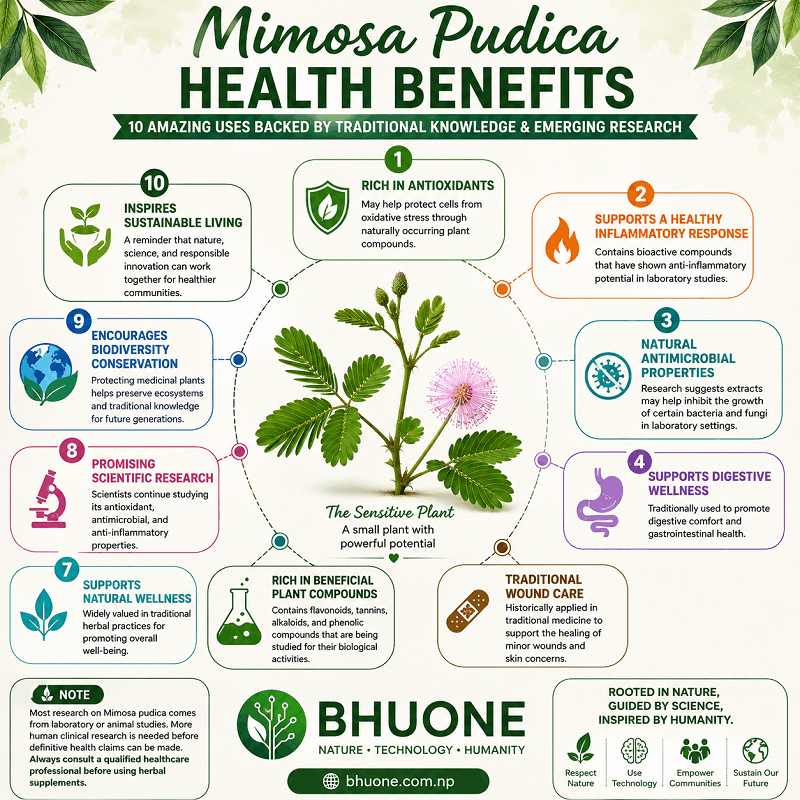
The plant belongs to the Fabaceae (Legume) family and naturally grows in tropical and subtropical climates, including many regions of Nepal.
Its rapid leaf movement serves as a defense mechanism against herbivores, making it one of nature’s most fascinating examples of plant intelligence.
However, the real interest today lies in its traditional medicinal value.
Traditional Uses Around the World
Different traditional healing systems have used Mimosa pudica for centuries.
Examples include:
- Minor wound care
- Digestive discomfort
- Diarrhea management
- Skin conditions
- Hemorrhoids
- Inflammatory conditions
- Traditional liver support
- Female reproductive wellness in some cultures
These uses come primarily from traditional medicine rather than modern clinical practice.
Why Scientists Are Interested
Researchers have identified numerous naturally occurring compounds inside Mimosa pudica, including:
- Flavonoids
- Alkaloids
- Tannins
- Terpenoids
- Glycosides
- Phenolic compounds
These phytochemicals may contribute to antioxidant, antimicrobial, and anti-inflammatory activities observed in laboratory studies.
However, laboratory findings do not automatically mean the same effects occur in humans, which is why larger clinical studies are still needed.
The World Health Organization (WHO) emphasizes the importance of integrating traditional medicine with scientific research and quality standards.
This distinction is important for responsible health communication.
Mimosa Pudica in Nepal’s Traditional Knowledge
Nepal is one of the world’s richest countries in medicinal plant diversity.
From the Himalayas to the Terai, communities have relied on herbal knowledge passed down through generations.
Although plants like:
- Tulsi
- Timur
- Chiraito
- Bojho
- Neem
are more widely recognized, Mimosa pudica is gradually receiving attention from herbal researchers and natural farming communities.
With increasing awareness about sustainable herbal products, Nepal has an opportunity to document indigenous knowledge while ensuring scientific validation.
The Science Behind Mimosa Pudica Health Benefits
Scientists around the world have been studying the biological activities of this fascinating plant.
Nepal is home to hundreds of medicinal herbs that have supported communities for generations. If you’re interested in discovering more native species, explore our guide to medicinal plants in Nepal.
Current research suggests potential properties including:
Antioxidant Activity
Oxidative stress contributes to aging and many chronic diseases.
Laboratory studies indicate that Mimosa pudica contains antioxidants capable of neutralizing free radicals.
Antioxidants help protect cells from damage, although more human studies are required before drawing medical conclusions.
Anti-inflammatory Potential
Inflammation is the body’s natural defense system.
Some plant compounds found in Mimosa pudica have shown anti-inflammatory activity in experimental studies.
Researchers continue investigating whether these findings can translate into safe therapeutic applications for humans.
Antimicrobial Properties
Several laboratory investigations suggest extracts of Mimosa pudica may inhibit the growth of certain bacteria and fungi.
These findings are encouraging but should not replace antibiotics or professional medical treatment.
Wound Healing Research
Traditional healers have long applied the plant to minor wounds.
Modern experimental studies indicate certain extracts may support tissue repair under laboratory conditions.
Human clinical evidence remains limited.
Digestive Health
Perhaps one of the most discussed Mimosa Pudica Health Benefits is its traditional use for digestive wellness.
Historically it has been used for:
- Mild digestive discomfort
- Traditional parasite management
- Supporting bowel health
Scientific research continues to investigate these traditional claims, particularly regarding gut microbiota and gastrointestinal function.
10 Amazing Mimosa Pudica Health Benefits
While scientific evidence continues to evolve, the following benefits are among the most commonly discussed in research and traditional medicine.
1. Rich Source of Natural Antioxidants
Antioxidants protect cells against oxidative damage.
Healthy antioxidant intake supports overall wellness and healthy aging.
2. Supports Digestive Wellness
Traditionally used for digestive balance, Mimosa pudica remains one of the most researched herbs for gastrointestinal health.
3. May Help Maintain Healthy Skin
Traditional applications include minor skin irritation and wound care.
Modern studies continue evaluating these effects.
4. Contains Anti-inflammatory Plant Compounds
Several naturally occurring phytochemicals show promising anti-inflammatory activity in laboratory settings.
5. Traditionally Used for Wound Care
Many indigenous healing systems have used crushed leaves externally for generations.
6. May Support Microbial Balance
Research continues exploring antimicrobial compounds naturally present within the plant.
7. Rich in Bioactive Phytochemicals
Flavonoids, tannins, and alkaloids contribute to ongoing pharmaceutical research.
8. Potential Liver-Protective Properties
Early animal studies have investigated protective effects against oxidative stress in liver tissue.
Human evidence remains insufficient.
9. Supports Traditional Herbal Medicine
Its long history demonstrates the value of preserving indigenous knowledge.
10. Encourages Biodiversity Conservation
One often-overlooked Mimosa Pudica Health Benefit extends beyond individual wellness.
Studying medicinal plants encourages:
- Biodiversity conservation
- Sustainable harvesting
- Community awareness
- Herbal research
- Nature appreciation
Protecting medicinal plants ultimately supports healthier ecosystems.
Why Mimosa Pudica Health Benefits Matter Today
Today’s world faces challenges that previous generations rarely imagined.
Modern lifestyles have brought:
- Increased stress
- Processed diets
- Environmental pollution
- Reduced physical activity
- Declining biodiversity
At the same time, interest in natural wellness has grown dramatically.
People increasingly seek plants that have both traditional history and emerging scientific evidence.
Mimosa pudica represents this intersection beautifully.
Rather than viewing it as a miracle cure, researchers see it as a valuable medicinal plant worthy of careful investigation.
This balanced perspective protects public health while encouraging scientific innovation.
A Growing Opportunity for Nepal
Nepal possesses extraordinary biodiversity.
Over thousands of medicinal plant species grow across the country’s diverse ecological regions.
With responsible cultivation, research, and conservation, medicinal plants could contribute to:
- Rural employment
- Sustainable agriculture
- Herbal entrepreneurship
- Scientific research
- Eco-tourism
- Community education
Instead of exporting only raw herbs, Nepal has the opportunity to create value-added products through ethical processing, quality assurance, and evidence-based branding.
BhuOne’s Perspective
At BhuOne, we see Mimosa Pudica Health Benefits as more than a health topic.
They represent an opportunity to reconnect with nature while embracing science.
Every medicinal plant reminds us that innovation does not always begin in a laboratory. Sometimes it starts quietly in forests, fields, and villages where traditional knowledge has been preserved for generations.
Our responsibility is to document that knowledge, test it with modern science, and use technology to protect—not exploit—our natural heritage.
Role of Technology, AI & Innovation in Unlocking Mimosa Pudica Health Benefits
For thousands of years, medicinal plants were discovered through observation, experience, and traditional wisdom. Today, however, we are entering an exciting era where artificial intelligence (AI), biotechnology, robotics, and precision agriculture are accelerating the discovery of plant-based solutions for human well-being.
Sustainable cultivation not only protects biodiversity but also strengthens rural livelihoods. Learn more about sustainable living and how small environmental actions create lasting impact.
At BhuOne, we believe the future of herbal medicine is not simply about harvesting more plants—it is about understanding them better through science and technology.
Several laboratory studies published through the National Center for Biotechnology Information (NCBI) have investigated the antioxidant and antimicrobial properties of Mimosa pudica.
AI Is Changing Herbal Research
Artificial Intelligence is transforming the pharmaceutical and agricultural industries by analyzing enormous amounts of biological data much faster than humans.
Researchers can now use AI to:
- Identify promising medicinal compounds
- Predict biological activities
- Compare phytochemicals with known medicines
- Analyze thousands of research papers within minutes
- Discover new combinations of plant compounds
Although Mimosa pudica has been studied for decades, AI is helping scientists identify which of its compounds deserve deeper clinical investigation.
Instead of testing every compound manually, machine learning models can prioritize the most promising candidates.
This reduces both research costs and development time.
Precision Farming for Medicinal Plants
One challenge facing Nepal’s medicinal plant industry is inconsistent quality.
Plants grown under different conditions often contain different concentrations of beneficial compounds.
Smart farming technologies can help solve this problem.
Examples include:
- Soil moisture sensors
- Climate monitoring systems
- Automated irrigation
- Drone-based crop observation
- Satellite monitoring
- Mobile farm management applications
These technologies allow farmers to produce more consistent medicinal plants while reducing waste.
For medicinal herbs like Mimosa pudica, quality matters just as much as quantity.
Robotics in Sustainable Agriculture
Agricultural robotics is no longer science fiction.
Modern robots can assist with:
- Weed management
- Precision harvesting
- Plant health monitoring
- Disease detection
- Automated irrigation
- Nursery management
For Nepal’s future agricultural workforce, robotics may reduce labor shortages while improving production efficiency.
Rather than replacing farmers, robots can support them by handling repetitive and physically demanding tasks.
DNA Research and Plant Authentication
One major issue in the herbal market is species misidentification.
Some medicinal products are accidentally—or intentionally—sold under the wrong botanical name.
Modern DNA barcoding technology allows researchers to accurately identify medicinal plants before they enter the supply chain.
This protects:
- Consumers
- Farmers
- Herbal companies
- Researchers
- Biodiversity
Reliable identification builds trust in herbal products.
Digital Knowledge Preservation
Many elderly healers possess valuable medicinal knowledge that has never been documented.
Unfortunately, this knowledge risks disappearing with each generation.
Digital platforms, mobile applications, and AI-powered knowledge bases can help preserve traditional wisdom while encouraging scientific validation.
Nepal has a unique opportunity to document local medicinal practices before they are lost forever.
Practical Ways to Apply Mimosa Pudica Health Benefits Responsibly
One of the biggest misconceptions surrounding medicinal plants is that “natural” automatically means “safe.”
In reality, every medicinal plant contains biologically active compounds.
Responsible use requires knowledge, moderation, and scientific awareness.
Below are practical ways people can appreciate Mimosa pudica without making unrealistic expectations.
1. Learn Before You Use
Before consuming any medicinal herb:
- Learn its scientific name.
- Understand traditional uses.
- Read reliable research.
- Consult qualified healthcare professionals if you have existing medical conditions.
Knowledge is always the best medicine.
2. Appreciate Its Botanical Value
Many people grow Mimosa pudica simply because it is fascinating.
Its rapid leaf movement makes it an excellent educational plant for:
- Schools
- Botanical gardens
- Science clubs
- Home gardens
Children often develop a lifelong interest in biology after observing this remarkable plant.
3. Support Biodiversity
Instead of harvesting wild populations irresponsibly, encourage:
- Sustainable cultivation
- Community nurseries
- Native habitat conservation
- Seed collection programs
Healthy ecosystems benefit everyone.
4. Buy Responsibly
If purchasing herbal products:
Look for:
- Botanical name
- Manufacturing details
- Expiry date
- Laboratory testing
- Trusted producers
- Proper packaging
Avoid products making unrealistic “miracle cure” claims.
5. Promote Scientific Literacy
Sharing evidence-based information is one of the most valuable contributions anyone can make.
When discussing Mimosa Pudica Health Benefits, distinguish between:
- Traditional uses
- Laboratory research
- Animal studies
- Human clinical evidence
This honesty builds long-term trust.
6. Encourage Local Research
Nepal’s universities have tremendous opportunities to study native medicinal plants.
Students in:
- Agriculture
- Pharmacy
- Biotechnology
- Environmental Science
- Forestry
- Medicine
can collaborate to investigate local herbal resources responsibly.
Research today may become tomorrow’s innovation.
Economic Opportunities Around Mimosa Pudica in Nepal
Medicinal plants are no longer limited to traditional herbal shops.
Globally, demand for natural wellness products continues to grow.
If managed responsibly, Mimosa pudica could become part of Nepal’s broader herbal economy.
Potential opportunities include:
Herbal Tea Research
Although Mimosa pudica is not commonly marketed as a tea, researchers could investigate safe formulations where appropriate.
Scientific evaluation must come first.
Botanical Gardens
Tourism centered around medicinal plants can educate visitors while generating income.
Interactive gardens featuring sensitive plants are especially attractive for families and schools.
Educational Kits
Schools increasingly seek science learning materials.
Imagine educational kits containing:
- Seeds
- Growing instructions
- Plant biology lessons
- QR-code video tutorials
Such projects combine education with entrepreneurship.
Plant Nurseries
Specialized nurseries focusing on medicinal and native plants can supply:
- Schools
- Universities
- Researchers
- Home gardeners
- Eco-tourism parks
Eco-Friendly Landscaping
Because of its unique movement, Mimosa pudica can become part of biodiversity-themed gardens and educational landscapes.
Scientific Cultivation
Rather than collecting wild plants, controlled cultivation could improve:
- Traceability
- Quality
- Sustainability
- Research consistency
Challenges and Honest Limitations of Mimosa Pudica Health Benefits
Honest discussions build credibility.
While many articles online portray Mimosa pudica as a miracle herb, reality is more nuanced.
1. Limited Human Clinical Studies
Most published research involves:
- Laboratory experiments
- Cell cultures
- Animal models
Large-scale human clinical trials remain limited.
This means many potential health benefits still require confirmation.
2. Traditional Use Does Not Equal Proven Medicine
Traditional medicine provides valuable clues for research.
However, historical use alone does not prove medical effectiveness.
Scientific validation remains essential.
3. Quality Varies
Medicinal plant composition depends on:
- Soil
- Climate
- Harvest timing
- Drying methods
- Storage conditions
Two plants grown in different environments may contain different levels of active compounds.
4. Safety Considerations
Some people should avoid self-medicating with herbal products without professional guidance.
This includes:
- Pregnant women
- Breastfeeding mothers
- Children
- Individuals taking prescription medications
- People with chronic illnesses
Natural products can still interact with medicines.
5. Overharvesting Threatens Biodiversity
If commercial demand increases without sustainable cultivation, natural populations may decline.
Responsible farming must always replace destructive wild harvesting.
6. Online Misinformation
Social media often spreads exaggerated health claims.
Statements such as:
- “Cures every disease”
- “Detoxifies everything”
- “Works instantly”
are not supported by scientific evidence.
Responsible education protects both consumers and traditional knowledge.
BhuOne Insight
At BhuOne, we believe that nature deserves both curiosity and respect.
Every medicinal plant teaches us two important lessons:
First, nature still holds countless discoveries waiting to be understood.
Second, scientific evidence should guide how we apply traditional knowledge.
Technology, AI, and modern research should never replace indigenous wisdom—they should strengthen it.
When communities, researchers, farmers, and innovators work together, medicinal plants become more than herbal resources.
They become catalysts for sustainable development, education, biodiversity conservation, and rural prosperity.
The journey of understanding Mimosa Pudica Health Benefits has only just begun.
And perhaps the greatest benefit of all is that this humble plant reminds us to slow down, observe nature carefully, and remain open to learning from the world around us.
Future Scope of Mimosa Pudica Health Benefits in Nepal
Nepal is one of the world’s richest countries in biodiversity. From the tropical plains of the Terai to the Himalayan highlands, thousands of medicinal plant species thrive in diverse ecosystems. While many herbs such as Chiraito, Jatamansi, Timur, and Bojho are already recognized, lesser-known plants like Mimosa pudica also deserve scientific attention.
The future of Mimosa Pudica Health Benefits lies not only in traditional herbal practices but also in research, innovation, sustainable cultivation, and value-added enterprises. If Nepal invests in responsible development, this modest plant could contribute to environmental conservation, rural livelihoods, education, and scientific discovery.
1. Research and Development
One of Nepal’s biggest opportunities is expanding research into medicinal plants.
Future studies could focus on:
- Bioactive compound identification
- Safety and toxicity assessments
- Clinical trials
- Sustainable cultivation methods
- Product quality standards
- Genetic diversity conservation
Universities, herbal industries, and government agencies can collaborate to transform traditional knowledge into evidence-based innovation.
2. Sustainable Commercial Cultivation
Instead of harvesting wild plants, farmers can cultivate medicinal herbs under controlled conditions.
Benefits include:
- Consistent quality
- Better traceability
- Reduced pressure on natural ecosystems
- Higher income potential
- Reliable supply chains
Community-based cultivation can also strengthen rural economies while protecting biodiversity.
3. Value-Added Herbal Products
Rather than exporting raw plant material, Nepal can develop value-added products such as:
- Botanical extracts
- Herbal research materials
- Educational botanical kits
- Dried specimen collections
- Organic nursery plants
- Botanical garden exhibits
Every step of local processing creates more employment and increases economic value.
4. Eco-Tourism and Botanical Education
Nature tourism is evolving beyond mountain trekking.
Medicinal plant gardens can become destinations for:
- Students
- Researchers
- Families
- Nature enthusiasts
- International visitors
Interactive demonstrations featuring the “Sensitive Plant” can make learning about plant biology both educational and memorable.
5. AI-Powered Herbal Databases
Artificial Intelligence can organize vast amounts of botanical information.
Future AI systems could help:
- Identify medicinal plants from images
- Predict suitable cultivation regions
- Detect plant diseases
- Translate traditional knowledge
- Recommend sustainable farming practices
Combining indigenous wisdom with AI could accelerate scientific discovery while preserving cultural heritage.
6. Youth Entrepreneurship
Many young Nepalis are searching for meaningful careers that combine technology, sustainability, and innovation.
Medicinal plants offer opportunities in:
- Organic farming
- Nursery management
- Herbal product development
- Scientific research
- Eco-tourism
- Agricultural technology
- Digital education
These emerging sectors can create employment while encouraging young people to stay connected to Nepal’s natural resources.
New Commerce Ideas Around Mimosa Pudica
At BhuOne, we believe every plant has the potential to inspire sustainable business—not through exploitation, but through responsible innovation.
Here are some ideas:
🌱 1. Educational Plant Kits
Create kits containing:
- Mimosa pudica seeds
- Eco-friendly pots
- Growing guide
- Plant biology booklet
- QR code linking to educational videos
These kits can be used in schools, colleges, and science clubs.
🌿 2. Botanical Experience Gardens
Develop interactive gardens where visitors can:
- Observe plant movements
- Learn about medicinal herbs
- Attend workshops
- Explore biodiversity trails
Such spaces promote environmental awareness while supporting eco-tourism.
📚 3. Digital Learning Platform
Build online resources that include:
- Plant identification
- Traditional uses
- Scientific updates
- Conservation practices
- AI-assisted learning tools
Knowledge becomes more valuable when it is accessible to everyone.
🔬 4. Citizen Science Projects
Communities can contribute to research by documenting:
- Plant locations
- Flowering seasons
- Soil conditions
- Local names
- Traditional knowledge
Citizen science strengthens conservation and encourages public participation.
🌍 5. Sustainable Seed Banks
Preserving native plant diversity today protects future generations.
Community seed banks help maintain genetic diversity while supporting research and restoration projects.
Common Myths and Truths About Mimosa Pudica Health Benefits
The internet contains thousands of articles about medicinal plants, but not all information is reliable. Understanding the difference between traditional knowledge and scientific evidence is essential.
| Myth | Truth |
|---|---|
| Mimosa pudica cures every disease. | No scientific evidence supports this claim. Research is ongoing, and no plant is a universal cure. |
| Natural means completely safe. | Natural substances can still cause side effects or interact with medications. |
| More is always better. | Excessive use of any herb may increase risks rather than benefits. |
| Laboratory studies prove human effectiveness. | Lab and animal studies are important first steps but do not replace human clinical trials. |
| Every Mimosa pudica plant has identical medicinal value. | Active compounds vary depending on soil, climate, cultivation, and harvesting practices. |
| Traditional use guarantees medical effectiveness. | Traditional knowledge is valuable but still requires scientific validation. |
| Wild harvesting is the best option. | Sustainable cultivation helps protect biodiversity and ensures long-term availability. |
By separating myths from facts, we can appreciate medicinal plants responsibly and support evidence-based wellness.
BhuOne Perspective: Nature, Technology & Humanity
At BhuOne, we see every medicinal plant as part of a much larger story.
A story where nature provides inspiration, technology expands understanding, and humanity chooses responsibility.
With more than eight years of experience in information technology and computing, I have seen how innovation can transform industries. Yet, the more I work with AI, automation, and digital systems, the more I realize that many of tomorrow’s solutions still begin in nature.
Plants like Mimosa pudica remind us that intelligence exists in many forms. A simple touch triggers a remarkable response, teaching us that even the smallest organisms have evolved sophisticated survival strategies.
Imagine a future where:
- AI helps identify medicinal plants in seconds.
- Farmers use smart sensors to cultivate herbs sustainably.
- Students learn botany through interactive digital platforms.
- Researchers collaborate globally while protecting indigenous knowledge.
- Communities generate livelihoods without damaging biodiversity.
This is the future BhuOne believes in.
We are not building a platform to sell ideas.
We are building a community that connects Nature, Technology, and Humanity—one thoughtful conversation at a time.
Conclusion
The journey of understanding Mimosa Pudica Health Benefits is still unfolding.
Traditional medicine has valued this fascinating plant for generations, while modern science continues exploring its antioxidant, antimicrobial, anti-inflammatory, and other potential properties. Although early findings are encouraging, much remains to be learned through rigorous clinical research.
For Nepal, Mimosa pudica represents more than a medicinal herb. It symbolizes an opportunity to preserve biodiversity, document indigenous knowledge, encourage sustainable farming, inspire young innovators, and build a stronger bridge between traditional wisdom and modern technology.
As readers, researchers, farmers, and citizens, we all have a role to play. By protecting our natural resources, supporting evidence-based research, and embracing innovation responsibly, we can create a future where both people and the planet thrive.
At BhuOne, we invite you to stay curious, respect science, value nature, and become part of a movement that believes sustainable progress begins with informed communities.
The next time you gently touch a Mimosa pudica plant and watch its leaves fold, remember that you are witnessing one of nature’s most fascinating survival strategies—and perhaps the beginning of many future discoveries.
Frequently Asked Questions (FAQs)
1. What are the main Mimosa Pudica Health Benefits?
Research suggests potential antioxidant, antimicrobial, anti-inflammatory, and digestive wellness properties. Many traditional uses are still being studied, and more human clinical research is needed.
2. Is Mimosa pudica safe to consume?
Safety depends on the preparation, dosage, and individual health conditions. Consult a qualified healthcare professional before using it as a supplement, especially if you are pregnant, breastfeeding, taking medication, or managing a chronic illness.
3. Does Mimosa pudica really remove parasites?
Some traditional practices and preliminary studies have explored this possibility, but current scientific evidence is not strong enough to confirm it as an effective treatment. It should not replace professional medical care.
4. Can Mimosa pudica be grown in Nepal?
Yes. It naturally grows in many tropical and subtropical regions of Nepal and can also be cultivated under suitable environmental conditions.
5. Why does Mimosa pudica close its leaves?
Its leaves fold when touched as a defense mechanism called thigmonasty, helping reduce damage from herbivores and environmental stress.
Final BhuOne Message
Nature has always been our greatest teacher. Technology helps us understand it better, but wisdom comes from respecting both scientific evidence and traditional knowledge. Let us continue exploring plants like Mimosa pudica with curiosity, humility, and a shared commitment to a healthier, more sustainable future. 🌿