

SpaceX Rocket Failure Explained: 11 Things Everyone Should Know
-
What Is SpaceX and Why Does Every Rocket Launch Matter?
Founded in 2002 by Elon Musk, SpaceX (Space Exploration Technologies Corp.) has become one of the world’s most influential aerospace companies. Its mission is to revolutionize space technology, reduce the cost of accessing space, and ultimately make humanity a multi-planetary civilization.
Over the years, SpaceX has achieved several groundbreaking milestones. It became the first private company to successfully send a spacecraft to the International Space Station (ISS), pioneered reusable rocket technology with the Falcon 9, developed the powerful Falcon Heavy launch system, and continues to test Starship—the largest and most powerful rocket ever built for future Moon and Mars missions.
Every SpaceX launch attracts global attention because the company is pushing the boundaries of modern engineering. Unlike traditional space missions, SpaceX follows a rapid development philosophy: build, test, learn, improve, and fly again. This approach allows engineers to identify weaknesses, collect valuable data, and continuously refine their technology.
Why Do Rocket Failures Happen?
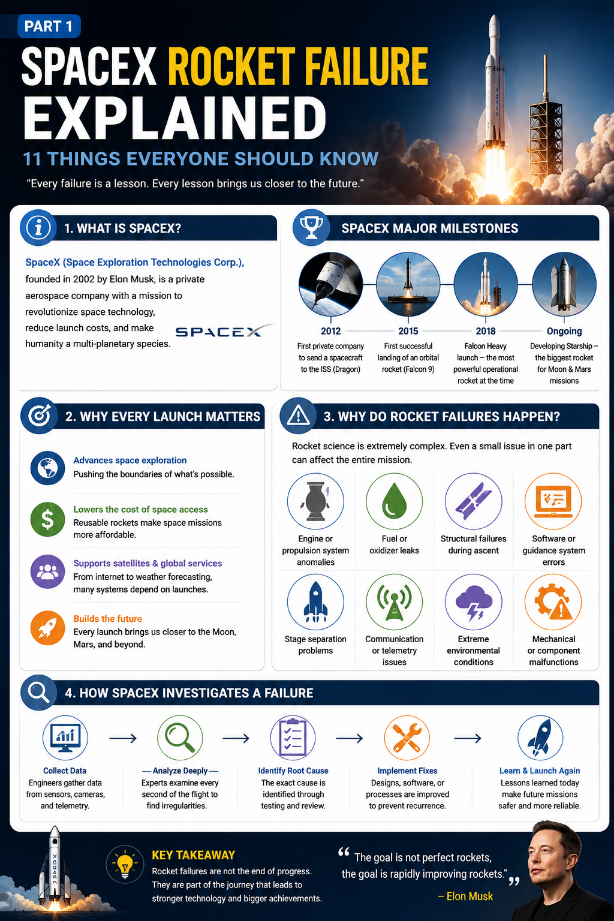
Rocket science is one of the most complex engineering disciplines in the world. A launch vehicle must perform perfectly while enduring extreme temperatures, intense vibration, massive pressure changes, and enormous speeds. Even a minor malfunction in a single component can affect an entire mission.
Some of the most common reasons for rocket failures include:
– Engine or propulsion system anomalies
– Fuel or oxidizer leaks
– Structural failures during ascent
– Software or guidance system errors
– Stage separation problems
– Communication or telemetry issues
– Extreme environmental conditions
Modern aerospace companies, including SpaceX, conduct extensive investigations after every unsuccessful mission. Engineers analyze flight data, sensor readings, telemetry, and onboard recordings to determine the exact cause before approving future launches.
Rather than viewing every failed mission as a defeat, the aerospace industry treats it as a valuable source of engineering knowledge. Many of today’s reliable launch systems were developed after years of testing, improvements, and lessons learned from earlier failures.
2. What Happened During the Latest SpaceX Rocket Failure?
The latest SpaceX Rocket Failure drew worldwide attention after the mission encountered a serious problem during its flight sequence. Although the launch began successfully and several key milestones were achieved, the mission did not complete exactly as planned. As with any major aerospace test, SpaceX immediately began collecting flight data to understand what happened.
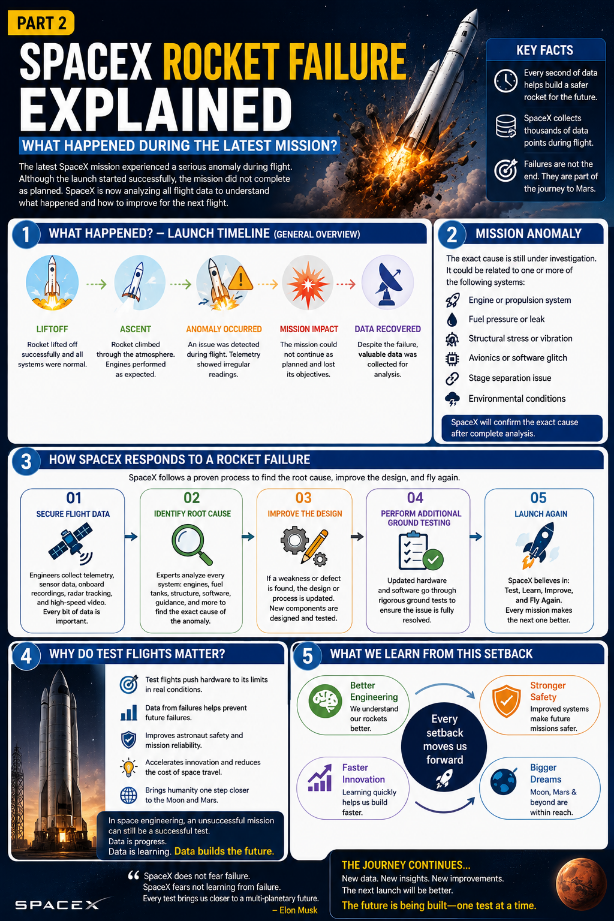
Engineers rely on thousands of sensors installed throughout the rocket. These sensors continuously transmit information about engine performance, fuel pressure, temperatures, structural loads, guidance systems, and communications. Even if a mission ends prematurely, this data is invaluable for improving future flights.
How Does SpaceX Respond to a Rocket Failure?
Unlike many industries where failure is considered the end of a project, aerospace engineering views every test flight as an opportunity to improve. SpaceX follows a rapid development philosophy:
Step 1: Secure Flight Data
Immediately after the incident, engineers collect telemetry, onboard recordings, radar tracking, and sensor data to reconstruct every second of the flight.
Step 2: Identify the Root Cause
Specialists examine every system, including engines, fuel tanks, avionics, structural components, software, and flight controls to determine exactly where the anomaly occurred.
Step 3: Improve the Design
If engineers identify a design weakness or manufacturing issue, the affected components are redesigned, tested, and validated before the next launch.
Step 4: Perform Additional Ground Testing
Updated hardware and software undergo extensive ground testing to ensure the issue has been addressed before another flight is attempted.
Step 5: Launch Again
SpaceX’s philosophy is simple: test, learn, improve, and fly again. Every mission provides new engineering knowledge that contributes to safer and more reliable rockets.
Why Do Test Flights Matter?
Many people assume that every rocket launch must be completely successful. In reality, experimental test flights are designed to push hardware to its limits. Engineers intentionally gather data under real flight conditions to validate new technologies that cannot be fully replicated on the ground.
The information collected from a single unsuccessful test can prevent future failures, improve astronaut safety, increase mission reliability, and accelerate the development of next-generation launch vehicles.
For this reason, aerospace experts often describe successful data collection as one of the most valuable outcomes of any experimental space mission—even when all mission objectives are not achieved.
3. Possible Causes Behind the SpaceX Rocket Failure
The SpaceX Rocket Failure has raised important questions among scientists, engineers, and space enthusiasts around the world. While the exact cause of any launch anomaly can only be confirmed after a thorough investigation, aerospace experts generally examine several critical systems that could contribute to a mission failure.
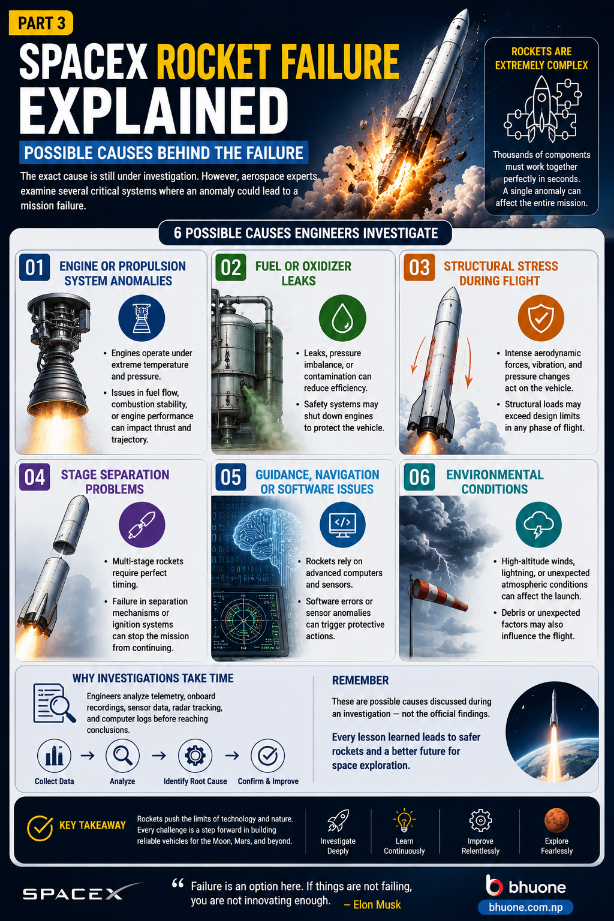
Modern rockets are among the most sophisticated machines ever built. Thousands of components must work together perfectly within seconds of liftoff. A single unexpected anomaly in hardware, software, or environmental conditions can affect the entire mission.
1. Engine or Propulsion System Anomalies
Rocket engines generate enormous thrust while operating under extreme temperatures and pressures. Even a minor issue involving fuel flow, combustion stability, or engine performance can impact the rocket’s trajectory and mission success.
2. Fuel or Oxidizer Leaks
Liquid-fueled rockets depend on precise mixtures of fuel and oxidizer. A leak, pressure imbalance, or contamination can reduce engine efficiency or trigger automatic safety systems designed to protect the vehicle.
3. Structural Stress During Flight
As the rocket accelerates through Earth’s atmosphere, it experiences intense aerodynamic forces, vibration, and changing pressure conditions. Engineers carefully analyze whether structural loads exceeded design limits during any phase of flight.
4. Stage Separation Problems
Most orbital rockets separate into multiple stages during ascent. This complex sequence must occur with perfect timing. If separation mechanisms or ignition systems fail to operate correctly, the mission may not continue as planned.
5. Guidance, Navigation, or Software Issues
Modern rockets rely on advanced computers that continuously calculate flight paths, engine adjustments, and vehicle orientation. Unexpected software behavior or sensor anomalies can cause the onboard flight computer to initiate protective actions.
6. Environmental Conditions
High-altitude winds, lightning, unexpected atmospheric conditions, or debris can influence a launch. Although weather is closely monitored before liftoff, engineers still evaluate environmental factors during every investigation.
Why Investigations Take Time
Determining the exact cause of a rocket failure is rarely immediate. Engineers analyze telemetry, onboard recordings, sensor data, radar tracking, and computer logs before reaching any conclusions. This careful process ensures that future missions benefit from accurate engineering improvements rather than assumptions.
For this reason, it is important to distinguish between possible causes discussed during an investigation and the official findings released after a complete technical review. Every lesson learned helps improve safety, reliability, and the future of space exploration.
4. Mission Timeline: From Liftoff to Launch Anomaly
Understanding the timeline of a rocket mission helps explain why every second of flight is critical. During a SpaceX Rocket Failure, engineers carefully examine each stage of the mission to determine exactly when the anomaly occurred and which systems were affected.
Although every launch follows its own mission profile, most SpaceX flights progress through a series of carefully planned phases. Each phase depends on the successful completion of the previous one.
🚀 Phase 1: Liftoff
The mission begins with engine ignition. Within seconds, the rocket generates millions of pounds of thrust, allowing it to overcome Earth’s gravity and begin its journey into space.
Engineers immediately monitor:
– Engine performance
– Fuel pressure
– Temperature
– Flight trajectory
– Vehicle stability
Even the smallest irregularity can trigger onboard safety systems.
—
☁️ Phase 2: Initial Ascent
As the rocket climbs through the atmosphere, it experiences increasing aerodynamic forces and intense vibration known as Max-Q—the point where structural stress is at its highest.
During this phase, onboard computers constantly adjust the rocket’s direction to maintain the planned flight path.
—
🔥 Phase 3: Mission Anomaly
If sensors detect unexpected behavior—such as engine performance changes, abnormal pressure, structural issues, or software irregularities—the flight computer may initiate automatic safety procedures.
Depending on the severity of the problem, the mission may continue, switch to backup systems, or end early to protect public safety.
—
🛰️ Phase 4: Telemetry & Data Collection
Even if the mission is interrupted, thousands of sensors continue transmitting valuable information until communication ends.
SpaceX engineers collect:
– Flight telemetry
– Engine data
– Pressure readings
– Structural measurements
– Camera footage
– Radar tracking
– Computer logs
This information becomes the foundation of the investigation.
—
🔍 Phase 5: Post-Flight Investigation
After the mission, engineers reconstruct the entire flight second by second. Every sensor reading is analyzed to identify the root cause and recommend improvements for future launches.
Rather than focusing solely on the outcome, SpaceX emphasizes continuous learning. Every mission—whether fully successful or not—provides critical engineering knowledge that helps build safer, more reliable, and more capable launch vehicles for future exploration beyond Earth.