
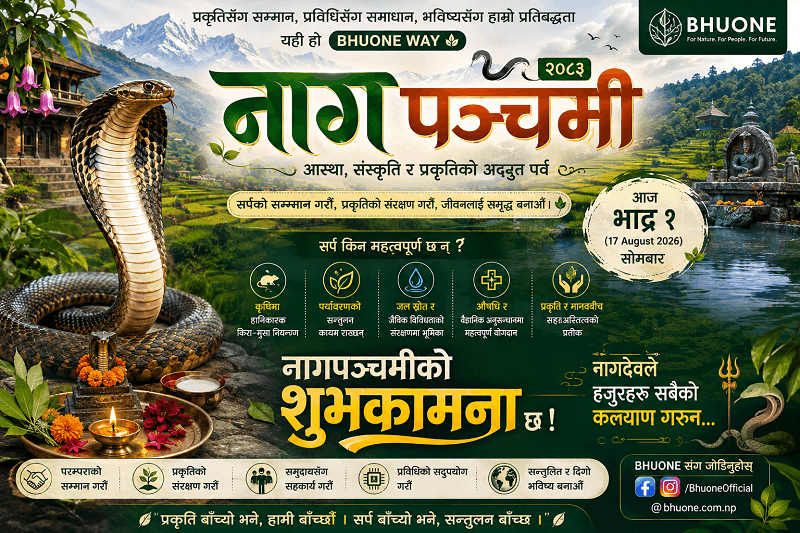
Nag Panchami 2026: 7 Powerful Reasons to Respect Snakes & Protect Nature
Introduction: From Fear to Respect
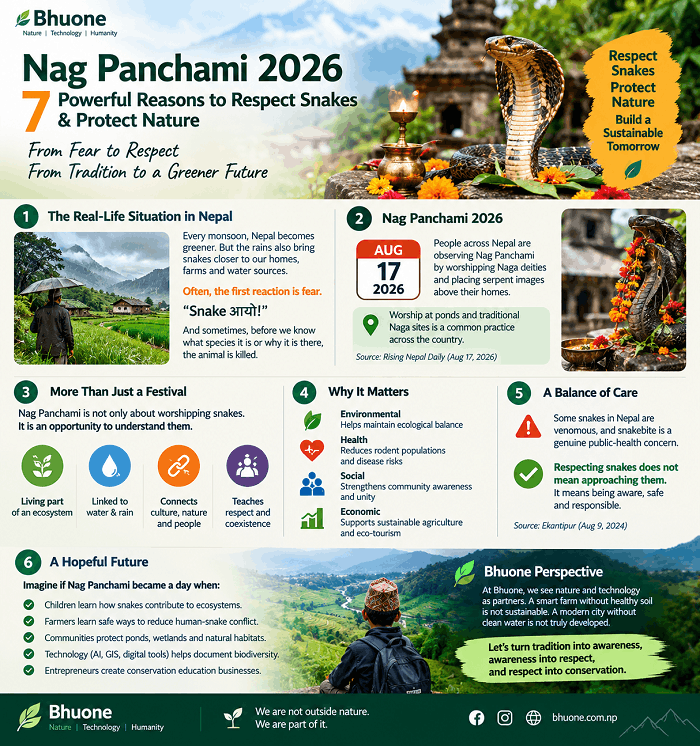
Every monsoon, Nepal becomes greener.
Rice fields fill with water, forests become dense, streams begin to flow, and life seems to return everywhere. But the monsoon also changes the relationship between people and wildlife. Snakes that normally remain hidden may become visible around farms, houses, roads, gardens and water sources.
For many people, the first reaction is fear.
“Snake आयो!”
And sometimes, before anyone knows what species it is or why it is there, the animal is killed.
This is where Nag Panchami 2026 gives us something important to think about.
Today, August 17, 2026, people across Nepal are observing Nag Panchami by worshipping Naga deities and placing serpent images above their homes. Reports from Nepal describe the festival being celebrated across the country, including worship at ponds and traditional Naga sites.
But perhaps this ancient festival can mean something more in our modern world.
Nag Panchami 2026 gives Nepal an opportunity to look at an ancient tradition through a modern environmental lens. The festival reminds us that snakes are not simply creatures to fear; they are part of the wider web of life surrounding our farms, forests, wetlands and communities. When we understand that connection, respect becomes more meaningful than fear.
Nag Panchami is not only about worshipping snakes. It can also be an opportunity to understand them.
It can remind us that the snake moving through a field is not necessarily an enemy. It is a living part of an ecosystem—a predator, prey, and participant in the complicated food web that connects soil, crops, insects, rodents, birds, water and forests.
Nepal Tourism Board describes Nag Panchami as a traditional festival in which people worship Nagas and make offerings associated with rain and prosperity. It also highlights important Naga-related sites such as Nagpokhari, Taudaha and Nagdaha in the Kathmandu Valley.
That connection between Naga, water, rain and nature is particularly interesting.
Our ancestors may not have used today’s words—biodiversity, ecosystem services, food webs, ecological balance or conservation technology—but they understood that humans were not completely separate from the natural world.
The relationship between Naga traditions and water is especially meaningful for Nepal. Ponds, lakes, springs and wetlands provide space for countless forms of life, while also supporting agriculture and local communities. Protecting these places is therefore not only about preserving cultural heritage. It is also about maintaining living ecosystems for future generations.
And modern science gives us another reason to pay attention.
Snakes play important ecological roles. They are predators within food webs and can help regulate populations of animals such as rodents and other small prey. Researchers and conservation organizations in Nepal have repeatedly highlighted the ecological importance of snakes and the need to reduce unnecessary human-snake conflict.
At the same time, we should not romanticize wildlife.
Respecting snakes does not mean approaching them.
Some snakes in Nepal are venomous, and snakebite is a genuine public-health concern, particularly in rural and agricultural communities. A nature-friendly message must therefore include safety, awareness and responsible behavior—not blind fear, but also not careless confidence.
This balance is exactly where tradition, science and technology can meet.
Imagine if Nag Panchami became not only a day of prayer, but also a day when:
- Children learn how snakes contribute to ecosystems.
- Farmers learn safe ways to reduce human-snake conflict.
- Communities protect ponds, wetlands and natural habitats.
- Young people use AI, GIS and digital tools to document biodiversity.
- Researchers receive better local wildlife observations.
- Technology helps connect communities with trained wildlife responders.
- Entrepreneurs create businesses around conservation education rather than wildlife exploitation.
That would give an ancient tradition a powerful modern dimension.
Why This Matters to Bhuone
At Bhuone, we see nature and technology as partners—not competitors.
Technology can help us automate farms, understand soil, monitor crops, map ecosystems and make better decisions. AI can process enormous amounts of information. Robotics can perform difficult tasks. Sensors can tell us what our eyes cannot see.
But technology should not make us forget the natural systems that keep us alive.
A smart farm without healthy soil is not truly sustainable.
A modern city without clean water is not truly developed.
And technological progress that destroys biodiversity cannot be called complete progress.
This is why Nag Panchami 2026 deserves a broader conversation.
It is a cultural and spiritual festival, but it can also become a doorway into environmental education.
It can teach us that respecting nature does not require us to be afraid of it.
It requires us to understand it.
And perhaps that is the most meaningful way to carry an old tradition into a changing future:
From worship to awareness.
From awareness to respect.
From respect to conservation.
Nepal has a remarkable opportunity to connect its cultural heritage with modern science, responsible technology and community-based conservation.
The snake may be small compared with the mountains around us.
But the lesson it carries is enormous:
We are not outside nature. We are part of it.
And if we learn to protect the systems that support other living beings, we may also become better at protecting ourselves.
🌱 This Nag Panchami, let us not only remember the Naga. Let us remember the ecosystem.
Understanding Nag Panchami 2026 in Nepal
When we hear the words Nag Panchami 2026, many of us immediately imagine a snake, a Naga image placed above a doorway, a temple decorated with flowers, or a family performing traditional rituals.
But the story is much deeper than a single religious ceremony.
In Nepal, Nag Panchami exists at the intersection of culture, spirituality, water, agriculture, nature and community life. It is a tradition that has travelled through generations, carrying stories about Nagas while keeping a strong connection between people and the natural world.
Understanding that background helps us see why this festival can still have meaning in the 21st century.
What Is Nag Panchami 2026?
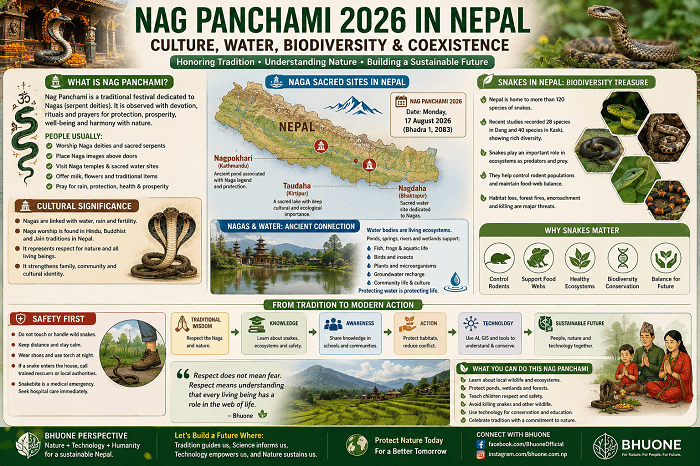
Nag Panchami 2026 is the annual observance dedicated to Nagas, traditionally represented as serpent deities.
In Nepal, Nag Panchami is observed according to the lunar calendar and is traditionally associated with the fifth day of the bright half of the lunar month of Shrawan. In 2026, Nag Panchami falls on August 17.
The festival is observed in different ways across Nepal, with local customs varying between communities.
People may:
- Worship images or representations of Nagas
- Place Naga images above doors
- Visit Naga temples and sacred water sites
- Offer flowers, milk and other traditional offerings
- Pray for protection, prosperity and well-being
- Share stories and traditions with younger generations
The Nepal Tourism Board recognizes Nag Panchami as an important traditional festival and highlights its connection with Naga worship, rainfall and prosperity. Important Naga-related sites in the Kathmandu Valley include Nagpokhari, Taudaha and Nagdaha. (Nepal Tourism Board)
This gives the festival a fascinating geographical connection.
Nagas are not only remembered inside temples.
They are also connected symbolically with ponds, lakes, springs, rivers and water sources.
And water is one of the most important elements of life in Nepal.
Nag Panchami 2026 and Nepal’s Relationship With Water
Nepal is a country shaped by water.
From Himalayan snow and glaciers to rivers, springs, ponds and monsoon rainfall, water influences agriculture, settlements, biodiversity and everyday life.
For centuries, communities have developed cultural relationships with water.
Traditional ponds and stone spouts were not merely beautiful structures. They were part of settlement systems that helped communities access and manage water.
This makes the connection between Nag Panchami 2026, Naga traditions and water particularly interesting.
In traditional beliefs, Nagas have often been associated with rain and water.
Modern environmental science gives us another reason to think about this connection.
Water bodies are ecosystems.
A pond is not simply a place containing water.
It can support:
- Fish
- Frogs
- Insects
- Aquatic plants
- Birds
- Reptiles
- Microorganisms
- Nearby vegetation
- Groundwater recharge
When a pond disappears under concrete, the loss is therefore larger than the visible water surface.
An entire ecological relationship can disappear with it.
This is why protecting traditional water bodies can serve both cultural heritage and environmental conservation.
Why Are Snakes Important in Nepal?
A common question is:
“Why should we protect snakes?”
The answer begins with biodiversity.
Nepal is geographically small compared with many countries, but its enormous variation in altitude, climate and habitat creates conditions for remarkable biological diversity.
Snakes are one part of that diversity.
Different species occupy different habitats and have different ecological roles.
Some live around agricultural landscapes.
Some are associated with forests.
Some occur around wetlands.
Others are adapted to grasslands, rocky areas or human-dominated environments.
They also have different diets and behaviors.
This means the word “snake” hides a surprisingly complex world.
A snake eating rodents in a farm ecosystem is participating in a different ecological relationship from a snake living in a forest and feeding on frogs or other reptiles.
This diversity matters.
A recent study from Dang documented 28 snake species belonging to 20 genera and seven families, including a species newly recorded for Nepal and several new records for Dang District. The researchers also identified threats including forest fires, habitat encroachment, construction and intentional killing. (Journal of Reptiles and Amphibians)
Research from Kaski has also documented substantial snake diversity, recording 40 species from five families in the study area. (Nepal Journal of Zoology)
These studies reveal something important.
We still have much to learn.
Even today, researchers continue documenting snake diversity and distribution in Nepal.
That means conservation is not simply about protecting animals we already know.
It is also about protecting opportunities to discover, understand and study the biodiversity that still exists.
Nag Panchami 2026: Culture Can Become a Conservation Bridge
One of the greatest strengths of Nag Panchami 2026 is its emotional connection.
People may not remember the scientific name of a snake.
They may not know its position in a food web.
They may not understand biodiversity indexes or habitat fragmentation.
But they may remember a story their grandmother told them about Nagas.
They may remember visiting a temple.
They may remember seeing a Naga image above their family’s doorway.
That emotional connection matters.
Conservation is not purely a scientific exercise.
People protect what they value.
And people often value what they understand emotionally.
This creates an opportunity.
Instead of separating tradition and science, we can allow them to support one another.
For example:
Traditional message:
“Respect the Naga.”
Modern environmental message:
“Respect the living animals and their habitats.”
Traditional connection:
“Nagas are associated with water and rain.”
Modern environmental connection:
“Protect ponds, wetlands, streams and natural water systems.”
Traditional value:
“Nature deserves respect.”
Modern action:
“Reduce unnecessary wildlife killing and human-wildlife conflict.”
This does not require changing the cultural meaning of Nag Panchami.
It simply expands the conversation.
Is Nag Panchami Only a Hindu Festival?
This question deserves a respectful and careful answer.
Nag Panchami is strongly rooted in Hindu traditions and is widely observed within Hindu communities.
However, serpent traditions and reverence for snakes are not limited to a single cultural worldview.
Snake and Naga symbolism also appears in different Buddhist traditions, Jain traditions and other South Asian cultural contexts.
In Nepal, religious and cultural traditions have historically interacted with one another.
The important point for a sustainability-focused discussion is not to erase these differences.
Instead, we can recognize that reverence for nature can become a shared point of understanding across communities.
At Bhuone, this broader perspective is important.
Nature does not ask us which community we belong to.
A river flows through different communities.
A forest supports different families.
Birds cross political boundaries.
Wildlife does not follow our social categories.
Environmental responsibility can therefore become a common language.
Nag Panchami can be understood through its cultural and spiritual roots while also becoming a wider conversation about biodiversity and coexistence.
Naga Worship and the Idea of Protection
There is something psychologically powerful about worship.
When a society gives symbolic importance to an animal, it creates a cultural reminder that the animal has value.
That does not automatically create conservation.
But it can create a foundation for conservation awareness.
Consider the difference.
If someone sees a snake only as a threat, the immediate response may be:
Remove it.
If someone understands that snakes have cultural, ecological and scientific value, the response can become:
Keep a safe distance and seek an appropriate solution.
That is a meaningful change.
The goal is not to make people love snakes.
People do not have to touch them, keep them as pets or feel comfortable around them.
The goal is simply to replace unnecessary destruction with informed coexistence.
That is a much more realistic conservation goal.
Nag Panchami 2026 and Farmers
The connection between snakes and agriculture deserves special attention in Nepal.
Agriculture remains closely connected with rural livelihoods, food security and local economies.
And agricultural landscapes are ecosystems.
A field may contain:
- Crops
- Rodents
- Insects
- Frogs
- Birds
- Earthworms
- Microorganisms
- Snakes
- Weeds
- Soil organisms
When we think only about the crop, we miss the system surrounding it.
Some snakes prey on rodents and other animals that interact with agricultural systems.
The World Health Organization notes that venomous snakes have ecological roles and can contribute to natural biological control of agricultural pests such as rodents. (World Health Organization)
This does not mean snakes should be introduced into farms or that farmers should ignore dangerous species.
That would be irresponsible.
Instead, it means farmers can benefit from understanding the ecological relationships already present around their farms.
This is where sustainable agriculture becomes more interesting.
Instead of asking:
“How do I eliminate everything I consider a pest?”
We can ask:
“How can I manage my farm while maintaining useful ecological relationships?”
That is the philosophy behind integrated and sustainable approaches to agriculture.
From Fear to Knowledge
Fear is not always irrational.
A venomous snake can be dangerous.
A person working barefoot in a field at night may genuinely face risk.
Children may not understand the difference between a harmless species and a venomous one.
So telling people simply “Don’t be afraid of snakes” is not good environmental education.
A better message is:
Don’t let fear become ignorance. Replace fear with knowledge and safe behavior.
That means:
Learn
Understand that Nepal has many snake species.
Observe
If you encounter a snake, maintain distance rather than approaching it.
Don’t Handle
Never attempt to pick up or capture an unfamiliar wild snake.
Protect Yourself
Use appropriate footwear and lighting when working or walking in environments where snakes may occur.
Seek Trained Help
If a snake enters a home or populated area, contact trained local wildlife or snake-rescue personnel where available.
Protect Habitat
Healthy ecosystems reduce the pressure created by habitat destruction and unnecessary wildlife conflict.
This balanced approach is essential.
Conservation without safety is irresponsible.
Safety without ecological understanding can become unnecessary killing.
We need both.
Nag Panchami 2026 as an Educational Opportunity
Imagine a school celebrating Nag Panchami 2026 differently.
Instead of only displaying a Naga image, students could learn about:
Food Webs
How predators and prey interact.
Biodiversity
Why different species matter.
Wetlands
Why ponds and water bodies support life.
Agriculture
How wildlife interacts with farms.
Safety
What to do when encountering a snake.
Technology
How AI, GIS and digital tools can help document biodiversity.
Students could even create a simple local biodiversity map.
They could record birds, insects, plants, frogs and other wildlife without disturbing them.
That activity would turn a cultural day into a science-learning experience.
It would also create something Nepal urgently needs:
young people who see nature as something to understand, not simply something to consume.
The Hidden Economic Value of Biodiversity
There is another reason Nag Panchami 2026 matters.
Biodiversity has economic value.
Healthy ecosystems support agriculture, water systems, tourism, education and scientific research.
When biodiversity disappears, the economic cost may not always be immediately visible.
A forest can disappear before people realize how much water regulation, soil protection, habitat and tourism potential it provided.
A wetland can be filled before the community realizes how many species depended on it.
A predator can disappear before anyone notices changes elsewhere in the food web.
This is why conservation should not always be presented as an expense.
It can also be viewed as an investment.
Investment in:
- Healthy ecosystems
- Sustainable agriculture
- Environmental education
- Eco-tourism
- Scientific research
- Green technology
- Local employment
- Community resilience
And this is where Nepal’s young generation can play a major role.
A New Way to Think About Nag Panchami
Perhaps the most powerful question for Nag Panchami 2026 is not:
“Should we worship snakes?”
For many people, the answer will already be connected to their traditions.
A more modern question is:
“What can our respect for snakes teach us about the way we treat nature?”
That question opens a much larger conversation.
It takes us from:
Snake → Naga → Culture → Nature → Biodiversity → Agriculture → Technology → Community
Suddenly, a single festival becomes a doorway into an entire ecosystem of ideas.
And that is where Bhuone sees an opportunity.
We don’t need to choose between our heritage and our future.
We can carry the wisdom of the past into a future supported by science and responsible technology.
From Ancient Wisdom to a Future of Coexistence
Our ancestors lived much closer to natural cycles.
They watched the sky.
They depended on rainfall.
They understood seasonal changes.
They knew where water came from.
They depended directly on forests and farms.
Modern technology has changed our lives enormously.
But it has not changed one fundamental fact:
We still depend on nature.
Our food comes from biological systems.
Our water comes from natural cycles.
Our oxygen comes through living systems.
Our soil depends on complex organisms.
Our climate is connected with forests, oceans, atmosphere and biodiversity.
Technology can help us understand these systems.
AI can analyze data.
Sensors can monitor environmental conditions.
GIS can map habitats.
Robotics can assist fieldwork.
Digital platforms can connect communities.
But technology should serve ecological understanding—not replace it.
That is the direction we believe Nepal should explore.
A Simple Message for Nag Panchami 2026
If there is only one message you remember from this part, let it be this:
You do not have to touch a snake to respect it.
You do not have to love snakes.
You do not have to remove every fear.
You simply need to understand that a wild snake has a role in nature—and that human safety and wildlife conservation can exist together.
Respect for wildlife must always include respect for human safety. A responsible approach does not encourage people to approach, touch or capture snakes. Instead, it encourages awareness, distance, proper precautions and professional assistance when necessary. Nag Panchami 2026 can therefore become an opportunity to promote both conservation awareness and practical safety education.
That is the bridge between tradition and science.
That is the opportunity behind Nag Panchami 2026.
And that is where our next conversation begins.
In the next section, we will explore why Nag Panchami matters today, including its connections with ecosystem balance, agriculture, human well-being, biodiversity, community awareness and Nepal’s emerging green economy.
For farmers, biodiversity can sometimes be an invisible partner. A healthy agricultural landscape contains many relationships between crops, insects, rodents, birds, frogs, reptiles and soil organisms. Understanding these relationships can help us move toward farming systems that depend less on unnecessary intervention and more on observation, prevention and ecological balance.
Because respecting a snake is only the beginning.
The bigger lesson is learning how to live responsibly within the ecosystem that supports us all.
🌱 Respect nature. Understand science. Use technology wisely. Build a future where people and biodiversity can coexist.
Nag Panchami 2026: From Tradition to Conservation, Innovation & a Better Future
The story of Nag Panchami 2026 does not have to end when the flowers are removed, the prayers are completed and the Naga image is taken down from the doorway.
Perhaps that is where the real story should begin.
A festival can give us a moment of attention.
What we do with that attention is up to us.
If Nag Panchami reminds us to respect snakes, we can ask what that respect looks like in everyday life. Can it mean protecting habitats? Can it mean teaching children about biodiversity? Can it mean helping farmers reduce human-wildlife conflict? Can technology help communities understand wildlife better?
Imagine a child learning about a snake not through a frightening social-media video, but through a classroom lesson about food webs, biodiversity and ecosystems. That small change in perspective can have a lasting impact. When children learn why different species matter, they become more curious about the natural world and more responsible toward the living environment around them.
We believe the answer is yes.
Because protecting nature is not about going backward.
It is about moving forward more intelligently.
Nag Panchami 2026: Why It Matters Today
Our relationship with nature is changing rapidly.
Cities are expanding. Agricultural land is changing. Roads and infrastructure are reaching new areas. Natural habitats are increasingly affected by human activity.
At the same time, people are becoming more dependent on technology.
This creates an important question:
Can technology help us rebuild our relationship with nature rather than weaken it?
For Bhuone, this is one of the most important questions of our generation.
Modern technology gives us new ways to understand biodiversity. Smartphones can document observations, GPS can record locations, GIS can reveal habitat patterns, and AI can assist researchers in organizing large amounts of information. The important principle is that technology should be used responsibly, with expert verification and respect for wildlife.
UNEP describes nature as fundamental to human health, food, economies and well-being, while warning that biodiversity and ecosystems are under increasing pressure.
That means biodiversity conservation is not a luxury.
It is connected with human well-being.
The snake is simply one small example of a much larger system.
When we understand one species, we begin to understand ecosystems.
When we understand ecosystems, we begin to understand agriculture.
And when we understand agriculture, we begin to understand our own dependence on nature.
Nag Panchami 2026 and Human Well-Being
There is an important balance we should maintain.
A nature-friendly message should never suggest that snakes are harmless.
They are wild animals.
Some species are venomous, and snakebite can be a serious medical emergency.
The World Health Organization estimates that 4.5–5.4 million people are bitten by snakes globally each year, with approximately 81,000–138,000 deaths from complications. Rural agricultural workers are among the groups at higher risk.
Nepal’s national snakebite-management guidelines similarly identify snakebite as an important occupational hazard for farmers and other people working in rural environments.
So what does respect mean?
It means neither extreme.
Not:
“Every snake is dangerous. Kill it.”
And not:
“Snakes are harmless. Go near them.”
The responsible message is:
Know the risk. Keep your distance. Protect yourself. Protect wildlife where safely possible.
That is real coexistence.
A Safer Way to Live Near Snake Habitat
Many snake encounters can be reduced through simple environmental and behavioral measures.
WHO recommends practical prevention measures such as using protective footwear, keeping areas around homes and pathways clear, reducing hiding places created by rubbish and construction materials, and using a light when walking outdoors at night.
For Nepal’s farms and rural communities, practical awareness can include:
- Wear appropriate footwear while working outdoors.
- Use a torch at night.
- Keep pathways reasonably clear.
- Avoid leaving piles of wood, rubbish or construction materials beside homes.
- Store food and grain properly.
- Reduce conditions that attract rodents around houses.
- Teach children not to approach unfamiliar wildlife.
- Never attempt to handle an unfamiliar snake.
- Seek trained assistance when a snake needs to be removed from a populated area.
These are not anti-snake measures.
They are human-safety measures.
And that distinction matters.
What to Do If a Snake Is Encountered
The safest first response is usually simple:
Stop. Step back. Give it space.
Do not corner it.
Do not throw stones.
Do not try to catch it for a photograph.
Do not encourage children to gather around it.
If the animal is in a place where people are at risk, seek help from appropriately trained local wildlife or snake-rescue personnel where available.
The goal should be to reduce conflict without creating another danger.
What If Someone Is Bitten?
Snakebite should be treated as a medical emergency when a venomous snake is suspected.
WHO recommends moving away from the snake, keeping the person as still and calm as possible, and getting to a health facility promptly. It also warns against relying on traditional first-aid methods or herbal remedies that can delay appropriate treatment.
Do not try to capture the snake to take to the hospital.
Human safety comes first.
Conservation should never mean taking unnecessary risks with human life.
Nag Panchami 2026 and Sustainable Agriculture
Now we reach an area especially important for Nepal.
Farming.
Agricultural fields are not empty spaces containing only crops.
They are living ecosystems.
A rice field can contain insects, frogs, birds, rodents, microorganisms, plants and predators.
Some snakes occupy a place within that system.
WHO notes that venomous snakes can play ecological roles, including the natural biological containment of agricultural pests such as rodents.
This does not mean snakes should be introduced into farms.
It means we should recognize ecological relationships that already exist.
For sustainable agriculture, this perspective is valuable.
Instead of thinking only in terms of:
Pest → Kill
we can increasingly think:
Ecosystem → Understand → Monitor → Manage
This is where integrated pest management, biodiversity and modern technology can work together.
A farmer using sensors, farm records and ecological observations can make better decisions than a farmer working only from assumptions.
And this is exactly where Nepal’s agricultural future could become exciting.
Role of AI, GIS and Technology in Nag Panchami 2026
Technology can become a bridge between people and biodiversity.
Imagine a future where a community can document wildlife without disturbing it.
Someone observes a snake from a safe distance.
They take a photograph.
A digital system records:
- Approximate location
- Date
- Habitat
- Photograph
- Weather conditions
- Observation notes
AI may assist with preliminary identification.
GIS can map observations.
Researchers can analyze patterns.
Conservation organizations can identify areas with frequent human-wildlife encounters.
Municipalities can use better information for environmental planning.
This is not science fiction.
The individual technologies already exist.
The challenge is connecting them responsibly.
AI-Assisted Snake Identification
Artificial intelligence can potentially assist with wildlife identification from photographs.
But there is an important rule:
AI should assist—not become the final authority.
A photograph may be unclear.
Lighting can change appearance.
Different species can look similar.
A wrong identification could create a safety risk.
Therefore, a responsible biodiversity application should provide something like:
Possible identification: X
Confidence: Moderate
Do not approach the animal. Verify with a qualified expert if necessary.
That is much better than an AI system confidently telling an inexperienced person:
“This snake is harmless. Pick it up.”
Technology should reduce risk, not create it.
GIS and Biodiversity Mapping
Geographic Information Systems can provide another powerful opportunity.
Imagine mapping:
- Snake observations
- Agricultural land
- Forests
- Wetlands
- Roads
- Settlements
- Water bodies
- Elevation
- Human-snake conflict reports
Over time, patterns may become visible.
Perhaps certain roads create repeated wildlife crossings.
Perhaps certain settlements experience more encounters during particular seasons.
Perhaps habitat changes are pushing wildlife toward farms.
Better information can lead to better planning.
This is where data becomes conservation infrastructure.
Nag Panchami 2026 and Community Science
Nepal does not need every biodiversity project to begin inside a laboratory.
Communities can participate.
A student can record a bird.
A farmer can document a frog.
A photographer can photograph a plant.
A teacher can organize a biodiversity walk.
A programmer can build a database.
A researcher can verify observations.
A municipality can use the resulting information.
This is called citizen science or community-based biodiversity documentation.
And it can create something more valuable than a database.
It can create environmental awareness.
People begin to notice what lives around them.
They start asking questions.
They stop seeing nature as background scenery.
They begin seeing it as a living system.
Nag Panchami 2026: New Economic Opportunities
Conservation is often discussed as though it only costs money.
But a healthy ecosystem can also create economic opportunities.
Nepal has enormous potential in this area.
1. Biodiversity Education
Young environmental educators can create workshops for:
- Schools
- Hotels
- Resorts
- Community organizations
- Farmers
- Tourism businesses
The product is not wildlife.
The product is knowledge.
2. Eco-Tourism
A well-managed nature destination can combine:
Landscape + culture + biodiversity + local food + storytelling
Visitors can learn about local ecosystems while supporting community businesses.
3. Nature Photography
Nepal’s biodiversity provides opportunities for photographers, filmmakers, bloggers and digital creators.
Responsible wildlife photography can become both a creative profession and a conservation tool.
4. Biodiversity Mapping Services
Young GIS professionals can support:
- Municipalities
- Community forests
- Researchers
- Conservation projects
- Tourism operators
5. Environmental Content Creation
There is growing demand for reliable environmental storytelling.
Young Nepali creators can produce:
- Nepali-language documentaries
- Educational videos
- Infographics
- Podcasts
- Websites
- School materials
6. Conservation Technology
Entrepreneurs can develop:
- Wildlife reporting platforms
- Biodiversity databases
- AI-assisted identification tools
- GIS dashboards
- Community alert systems
- Educational applications
The opportunity is enormous.
And importantly, these businesses can create economic value without exploiting wildlife.
New Commerce Idea: The Biodiversity Economy
Perhaps Nepal needs to think beyond the traditional definition of commerce.
Commerce does not always have to mean:
Take → Process → Sell
There is another model:
Understand → Educate → Protect → Create Value
Imagine a local community developing a biodiversity-learning destination.
The community could earn through:
- Guided nature walks
- Educational workshops
- Homestays
- Local food
- Handicrafts
- Photography experiences
- School programs
At the same time, the community has an economic reason to protect the ecosystem.
That is powerful.
When conservation and livelihoods support each other, environmental protection becomes more sustainable.
Nag Panchami 2026 and Green Entrepreneurship
Young entrepreneurs in Nepal could build completely new businesses around biodiversity.
Here are some possibilities.
“Know Your Snake” Nepal
A verified Nepali-language educational platform explaining local snake species, habitats and safety.
Biodiversity School Box
Monthly educational packages containing:
- Species cards
- Ecosystem activities
- Posters
- Field notebooks
- QR-linked videos
- Local biodiversity challenges
Community Wildlife Network
A platform connecting communities with verified wildlife responders.
AI Nature Guide
A multilingual AI assistant providing educational information about plants, animals and ecosystems while clearly communicating uncertainty.
Biodiversity Mapping Service
A professional service helping schools, municipalities and communities document local biodiversity.
Eco-Festival Experiences
Responsible tourism experiences built around cultural festivals, wetlands, forests and local ecological knowledge.
These are examples—not promises of guaranteed profit.
The important idea is that conservation itself can inspire innovation.
A new generation of Nepali entrepreneurs can build businesses where environmental responsibility is part of the business model. Biodiversity education platforms, nature-learning programs, wildlife information services, GIS mapping, eco-tourism and digital conservation tools are examples of areas worth exploring. The future of green commerce may increasingly be about creating economic value while keeping ecological value intact.
Challenges We Cannot Ignore
A beautiful idea is not enough.
If Nag Panchami is going to become a stronger conservation conversation, we must acknowledge the limitations.
Fear Is Real
People who have experienced snakebite or seen someone harmed may understandably be afraid.
We should never shame them for that fear.
Education should provide safer choices.
Identification Is Difficult
Social media has created an illusion that everyone can identify wildlife from a photograph.
That is not always true.
Incorrect identification can create dangerous decisions.
Habitat Loss Is Complex
Wildlife conflict cannot always be solved by simply telling people to “protect nature.”
People need homes.
Farmers need land.
Roads and infrastructure are necessary.
The solution requires better planning—not unrealistic expectations.
Conservation Needs Local Participation
A solution designed without farmers, communities and local governments may fail.
Local knowledge matters.
Technology Has Limitations
AI can make mistakes.
Sensors can fail.
Data can be incomplete.
Algorithms can be biased.
Technology should therefore support human expertise, not replace it.
Common Myths About Snakes
Myth 1: Every snake is dangerous.
Truth: Different snake species have different characteristics. Some are venomous; many are not.
The safest response to an unfamiliar wild snake is still to maintain distance.
Myth 2: Killing snakes is the easiest way to protect farms.
Truth: Snakes can occupy important predator roles, including feeding on rodents and other prey. WHO specifically recognizes their ecological role in agricultural pest regulation.
Myth 3: Respecting snakes means touching them.
Truth: Absolutely not.
Respecting wildlife often means giving it space.
Myth 4: AI can identify every snake correctly.
Truth: AI can assist with identification, but uncertainty and expert verification remain important.
Myth 5: Tradition and science are opposites.
Truth: Cultural traditions can inspire environmental awareness, while science can help us understand the ecological systems behind the natural world.
Myth 6: Conservation means stopping development.
Truth: Conservation is about finding better ways for development and ecosystems to coexist.
Panchami 2026: Six Things You Can Do Today
You don’t need to become a wildlife researcher.
Start with small actions.
1. Learn
Read about the snakes and biodiversity of your local area.
2. Teach
Tell children that wild animals should be respected and observed from a safe distance.
3. Protect
Keep ponds, wetlands, forests and natural vegetation from unnecessary destruction.
4. Stay Safe
Use lights at night and appropriate footwear when working outdoors.
5. Document Responsibly
If you photograph wildlife, do so from a safe distance without disturbing it.
6. Share Accurate Information
Don’t post sensational or misleading snake content simply to get views.
One accurate post can educate more people than one hundred fear-based videos.
A Future Snake Panchami in Nepal
Imagine Nag Panchami ten years from now.
A school in Kathmandu is teaching children about local biodiversity.
A farmer in the Terai is using safer practices around fields.
A community forest has a digital biodiversity map.
A young Nepali programmer has developed an open-source wildlife reporting tool.
A municipality uses GIS data to understand human-wildlife conflict.
A tourism company creates a responsible biodiversity experience.
A researcher receives thousands of verified community observations.
And families continue placing Naga images above their doors.
The tradition has not disappeared.
It has evolved.
Culture remains. Science grows. Technology helps. Nature benefits.
That is the future we should work toward.
Bhuone Perspective: Nature + Technology + Humanity
At Bhuone, we often think about the future through technology.
AI.
Automation.
Robotics.
Smart farming.
Digital systems.
Data.
But the more we explore technology, the more obvious one truth becomes:
Technology is not the destination.
It is a tool.
A powerful tool—but still a tool.
A sensor can tell us the moisture level of soil.
It cannot love the forest.
An AI model can analyze thousands of wildlife observations.
It cannot replace the relationship a local community has with its landscape.
A robot can automate a difficult task.
It cannot decide what kind of future humanity should build.
Those decisions remain ours.
That is why Bhuone’s philosophy is built around the connection between:
Nature + Technology + Humanity
We want technology that helps farmers rather than disconnecting them from their land.
We want AI that helps us understand complex systems.
We want automation that reduces waste.
At Bhuone, we believe the future should not force us to choose between nature and technology. We need both. Nature provides the systems that sustain life, while technology can help us understand, monitor and protect those systems. The real challenge is not whether we have powerful technology, but whether we use that power with enough wisdom and responsibility.
We want young people to build businesses that create value without destroying ecosystems.
And we want communities to remain at the center.
Because sustainability is not just a technology problem.
It is a human problem.
Panchami 2026: From Worship to Responsibility
Perhaps this is the deeper message behind this festival.
We can begin with worship.
Then move toward understanding.
Understanding can create respect.
Respect can lead to responsible action.
And responsible action can become conservation.
Worship → Awareness → Respect → Action → Conservation
This doesn’t ask anyone to abandon their beliefs.
It simply asks us to expand what respect means.
If we respect the Naga, we can also respect the pond.
If we respect the pond, we can respect the wetland.
If we respect the wetland, we can respect biodiversity.
If we respect biodiversity, we begin to understand our own dependence on nature.
And suddenly, Nag Panchami becomes much larger than a single day.
The deeper message of Nag Panchami 2026 is therefore bigger than the snake itself. It asks us to think about how humans coexist with other species, how communities manage natural resources and how modern development can respect ecological limits. Once we begin asking these questions, a traditional festival becomes a meaningful conversation about the future.
Conclusion: Let Snake Panchami Become a Promise to Nature
Nag Panchami 2026 is a moment to remember.
A moment connected with culture, spirituality, water, rain, community and the natural world.
But it can also become a modern environmental message.
We can respect snakes without approaching them.
We can protect people without destroying wildlife.
We can support farmers while maintaining ecological balance.
We can use AI without replacing human judgment.
We can build businesses without exploiting nature.
And we can preserve traditions while allowing their deeper values to guide the future.
The snake does not need us to worship it every day.
It needs a place to exist.
The farmer does not need an ecosystem lecture every morning.
The farmer needs safe, practical and affordable solutions.
The child does not need to become a zoologist.
The child simply needs to learn that another living creature does not have to become an enemy simply because we do not understand it.
Perhaps the most beautiful lesson is simple: we do not need to touch wildlife to respect it. We can admire from a distance, learn from science, protect habitats, improve safety and teach the next generation. That is a practical form of respect—one that turns tradition into awareness and awareness into responsible action.
And technology?
Technology needs direction.
We decide what we build.
So perhaps the real lesson of Nag Panchami is not simply:
“Respect snakes.”
It is:
Respect the relationships that make life possible.
The relationship between water and soil.
Between soil and crops.
Between crops and people.
Between predators and prey.
Between forests and rainfall.
Between biodiversity and human well-being.
Between technology and responsibility.
We are not outside this system.
We are part of it.
That is why the future of Nepal should not be a choice between tradition and technology.
It should be a future where:
Tradition gives us values.
Science gives us understanding.
Technology gives us tools.
Communities give us action.
And nature gives us life.
This Snake Panchami, let us carry that message beyond the festival.
Let us learn before we fear.
Let us protect before we destroy.
Let us innovate without forgetting nature.
And let us build a Nepal where people, technology and biodiversity can grow together.
🌱 Respect Nature. Use Technology Wisely. Protect Biodiversity. Build the Future Together.
This is the Bhuone perspective.
Join the Conversation
Bhuone is built around the idea that meaningful change happens when people, ideas and technology come together.
Share your thoughts, nature stories, farming experiences and sustainability ideas with the Bhuone community.
Facebook: BhuoneOfficial
Instagram: @bhuone.com.np
Let’s move from awareness to action.
🌱 Nature + Technology + Humanity
Recommended Internal Links
- Sustainable Farming in Nepal — when discussing snakes, agriculture and ecological pest management.
- AI-Driven Sustainable Farming in Nepal — when discussing AI, sensors, automation and technology.
- Sustainable Living in Nepal — near the conclusion when expanding the discussion from snakes to responsible living.
Recommended External Authority Links
- World Health Organization — Snakebite Envenoming
- WHO — Preventing and Controlling Snakebite Envenoming
- UNEP — Nature and Biodiversity
These are strong authority references for the ecological, safety and human-well-being claims in the article.